The Last Summer

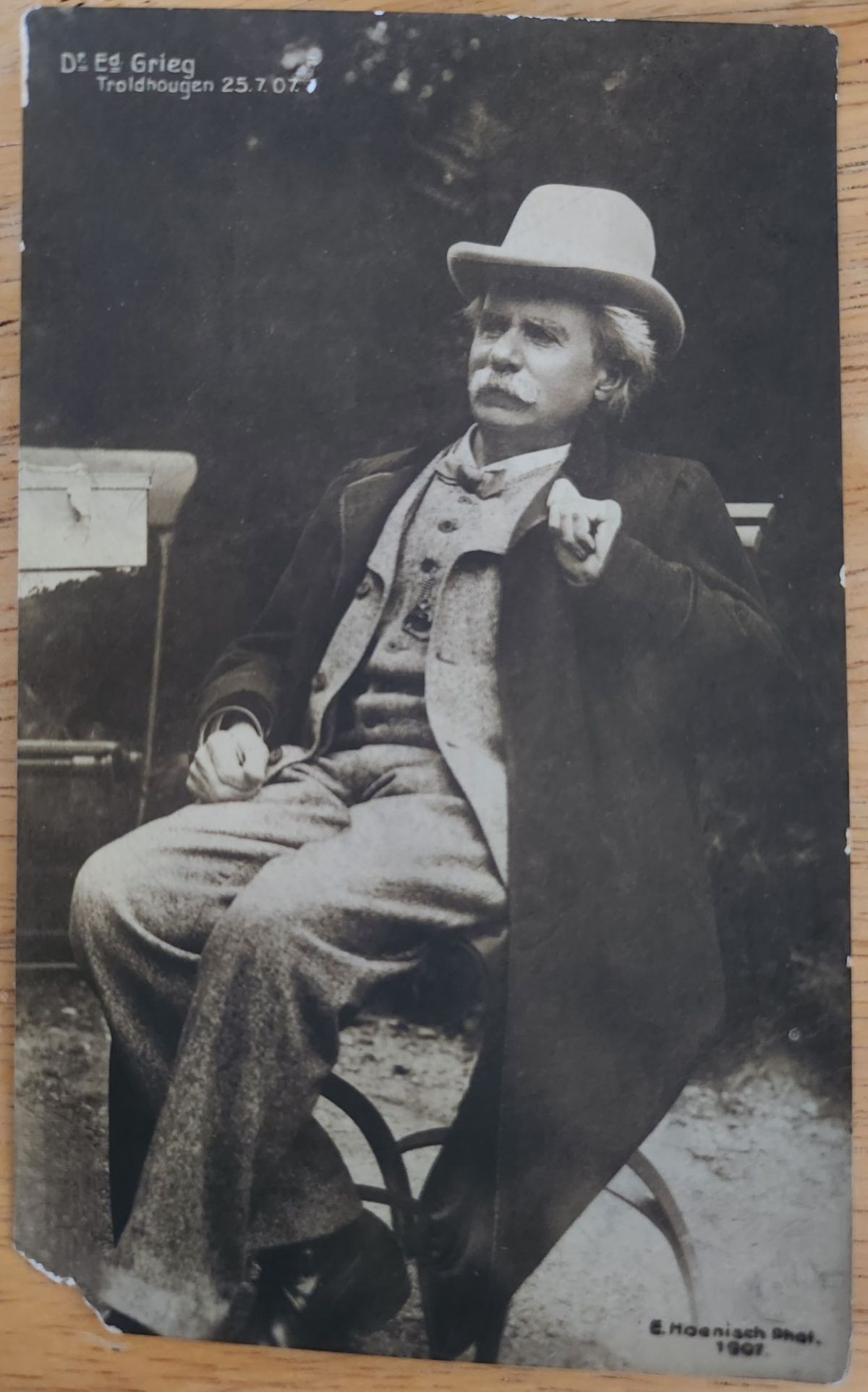
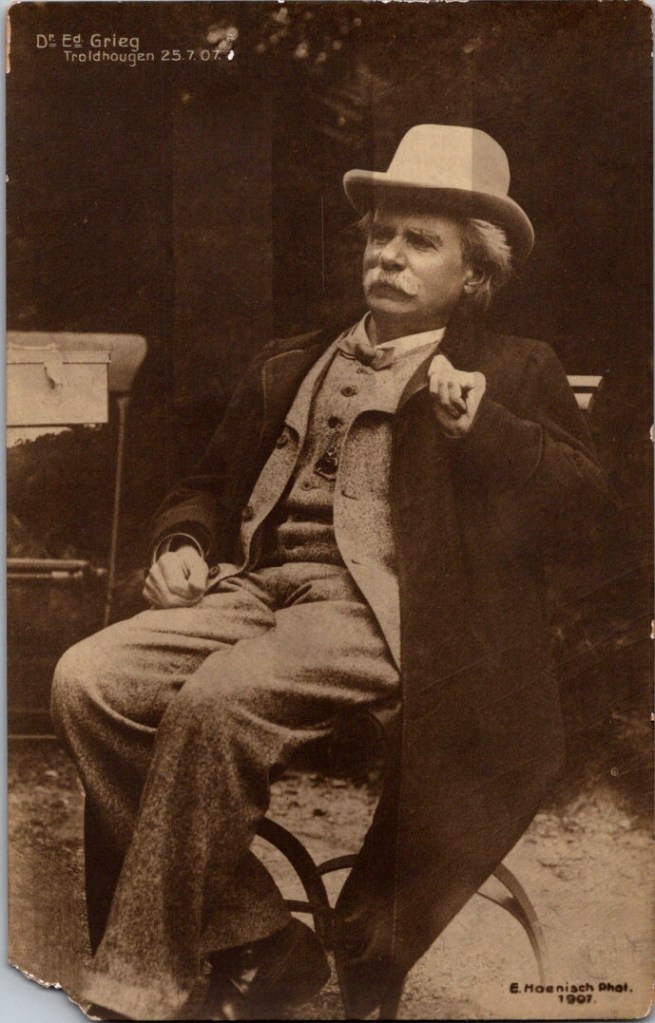
A Hoenisch Portrait of composer Edvard Grieg at Troldhaugen, July 25, 1907. Six weeks after this photograph was made, Edvard Grieg was gone.

The front of the card is a photogravure portrait in deep black and glowing white, printed full bleed with slightly rounded corners on stiff card stock. A man sits outdoors in a wooden chair, holding the lapel of his dark overcoat, loosely arranged to show a full suit, waistcoat, and bowtie. A white hat sits lightly on a head of wild silver hair. His mustache is full, his gaze lifted and distant. He looks content, a man six weeks from death.

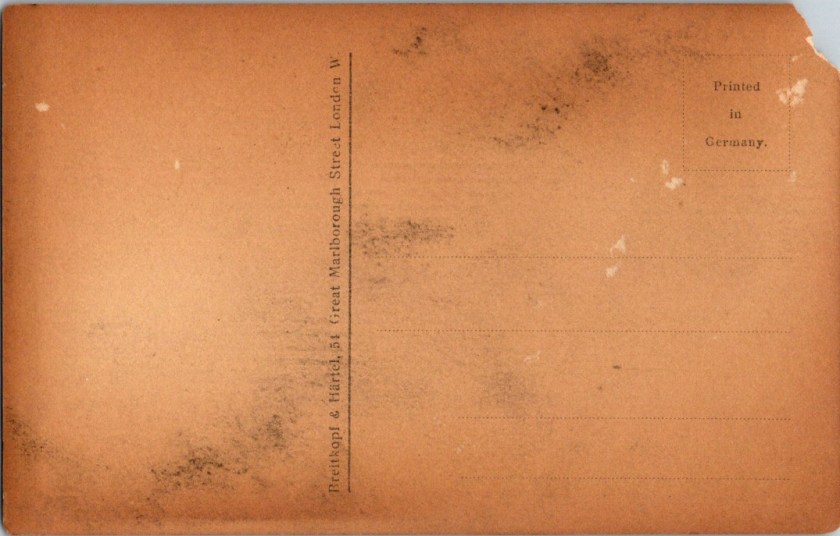
Stylized script in the upper left identifies the subject and moment: Dr. Ed. Grieg / Troldhougen 25.7.07. The photographer’s credit in the lower right reads: E. Hoenisch Phat. 1907. The back carries the publisher’s imprint: Breitkopf & Härtel, 51 Great Marlborough Street London W. A stamp box reads Printed in Germany. The card is unposted and unwritten, with amber flocking on the reverse and damage to the lower left corner.

The photogravure production quality is exceptional, revealing the highlights of Grieg’s white hat and the deep shadows of his coat, detail and dimensionality from century’s old technology. Breitkopf & Härtel were not postcard publishers. They were Grieg’s music publisher, one of the oldest and most prestigious houses in Europe, with Leipzig roots and a London office at the address printed on this card’s back. Their choice of photogravure signals deliberate intent. This is a prestige object, a rare souvenir of a celebrated composer.

Troldhaugen, Troll Hill, sits on a small wooded peninsula jutting into Nordåsvannet, a freshwater lake south of Bergen. Grieg built his pale wooden villa there in 1885, with a panoramic tower and large windows opening onto the water. He called it his best opus so far. By 1891 he had added a small composing hut at the lake’s edge: a piano, a desk, a rocking chair, a view over the water that he described as essential to his work. When he left it for the day he placed a handwritten note on the desk, a humble request.

If anyone should break in here, please leave the musical scores, since they have no value to anyone except Edvard Grieg.

Late July in Bergen is the city’s warmest season, though warm is a relative term. Long northern light persisting until nearly ten at night, the lake surface holding the soft diffuse luminescence of a Bergen summer afternoon.

Nina Grieg, Edvard’s wife and the foremost interpreter of his songs, presided over evenings in the living room around the 1892 Steinway. The house was full that summer. Julius Röntgen was there, the Dutch-German composer who had been Grieg’s closest musical confidant for twenty-four years. Their friendship is exhibited through more than two hundred letters, a deep enough connection that Grieg composed a short piece the previous year titled Sehnsucht nach Julius.

Percy Grainger, twenty-four years old and already an electrifying pianist, had arrived for what would become ten extraordinary days. Grieg had encountered Grainger in London the previous year and noted it in his diary.

I had to become sixty-four years old to hear Norwegian piano music interpreted so understandingly and brilliantly. He breaks new ground for himself, for me, and for Norway.

Ernst Hoenisch was thirty-two years old and already the leading musical photographer in Leipzig. He opened his atelier in 1903, and held the designation Hoffotograf, a court photographer’s appointment conferred by royal warrant. His roster of subjects over the following decades includes masters of musical life: Max Reger, Zoltán Kodály, and a young Kurt Weill.

The publishers Breitkopf & Härtel were also a Leipzig institution. The city’s musical world was compact and interconnected, its photographers, publishers, and performers in continuous orbit around one another. Hoenisch was almost certainly sent through the publisher to document Grieg in his final summer at the home where so much of his music had been written. He arrived into one of the most extraordinary musical gatherings of the era.

From the National Library of Norway Bergen Library Grieg Archives

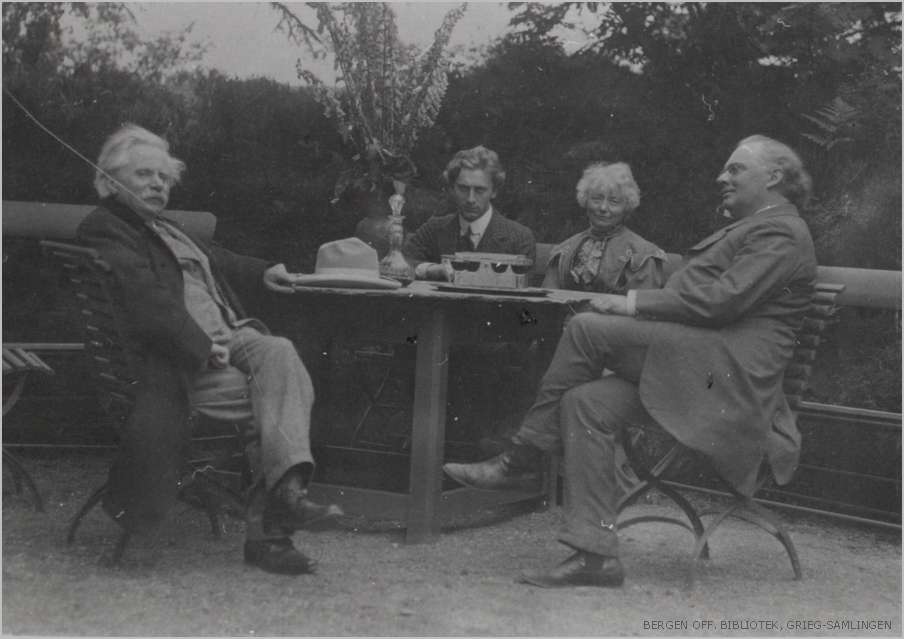
On July 25, that light fell across the garden where Hoenisch set up his camera. Edvard and Nina Grieg, Röntgen, and Grainger gathered at a garden table. An image from the National Library of Norway Bergen Library Grieg Archives captures them together. Grieg is wearing the identical suit, overcoat, and white hat that is visible on our card. Perhaps Hoenisch made the casual group image and then later captured the iconic portrait. A man alone and at rest in the place he loved most, surrounded by the people who understood his music best.

Grieg had been ill for years. A collapsed lung from tuberculosis contracted as a teenager at the Leipzig Conservatory shadowed his entire adult life. By 1907 his condition had deteriorated into combined lung and heart failure, with repeated hospitalizations. When Röntgen said his final farewell at Troldhaugen that summer, he knew they may not meet again.

In September, Grieg prepared to travel to England, where Grainger was to perform his Piano Concerto at the Leeds Festival. He collapsed in Bergen on the way to the ferry, was admitted to hospital, and died the following morning, September 4, 1907. His last words were: Well, if it must be so.

Forty thousand people filled the streets of Bergen for his funeral. His ashes were interred in a grotto in the cliff face above Nordåsvannet, at a spot he had chosen years earlier while fishing with a friend, where the last light of the day touched the rock. Here I want to rest forever, he said.


To Read More

Edvard Grieg — Britannica: https://www.britannica.com/biography/Edvard-Grieg

Bergen Public Library Grieg Archive — Flickr collection: https://www.flickr.com/photos/bergen_public_library/collections/72157617382486774/

Bergen Public Library Grieg Archive catalog: https://mitt.bergenbibliotek.no/cgi-bin/websok-grieg

Röntgen and Grieg — Julius Röntgen Foundation: https://www.juliusrontgen.nl/en/life/rontgen-and-grieg/

Grieg and Grainger — Piano Concerto site: http://griegpianoconcerto.com/grainger/biog.cfm

Ernst Hoenisch — Deutsche Fotothek professional record: https://www.deutschefotothek.de/documents/kue/90056238

The Fool Knows

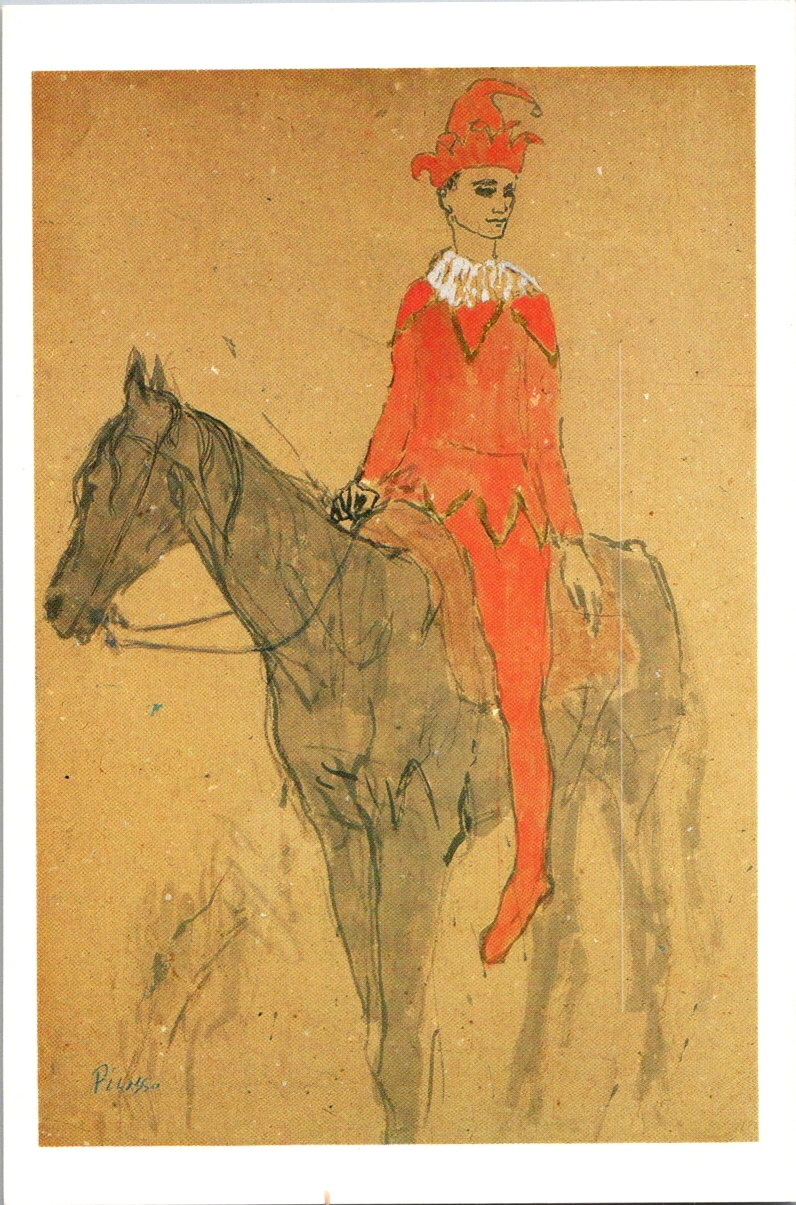
A fool in full red tunic, tights, and pointed cap riding a half-finished horse. In 1905, Picasso was 23 and in the middle of his Rose Period, when circus performers, acrobats, and jesters were recurring dreams. He saw what the Fool knows, and the rest of us learn along the way.

No one can quite pin down the origin of April Fool’s Day. One theory traces it to the shift from the Julian to the Gregorian calendar in 1582, and New Year’s Day from April 1 to January 1. Those who merrily celebrated the old date were mocked for their foolishness. Other evidence points to the Roman festival of Hilaria at the end of March, when people dressed in disguises and merriment was mandatory. A third argument simply blames the weather. Spring being notoriously unreliable, the fool is the farmer who trusts an early warm day.

Every court kept a fool, the one person licensed to speak the subtext. Under cover of bells and absurdity, they told the king what the courtiers would never. They didn’t matter and slipped away deftly, so they got away with it.

Shakespeare’s fools still deliver their wisdom from the stage. Touchstone sees everyone clearly in As You Like It. Feste in Twelfth Night diagnoses each character’s self-deception with a song. The Fool’s detachment is not ignorance; their folly is not fantasy. It is practical sense and functional freedom. The fool is often the one who tells the full tale as we go.

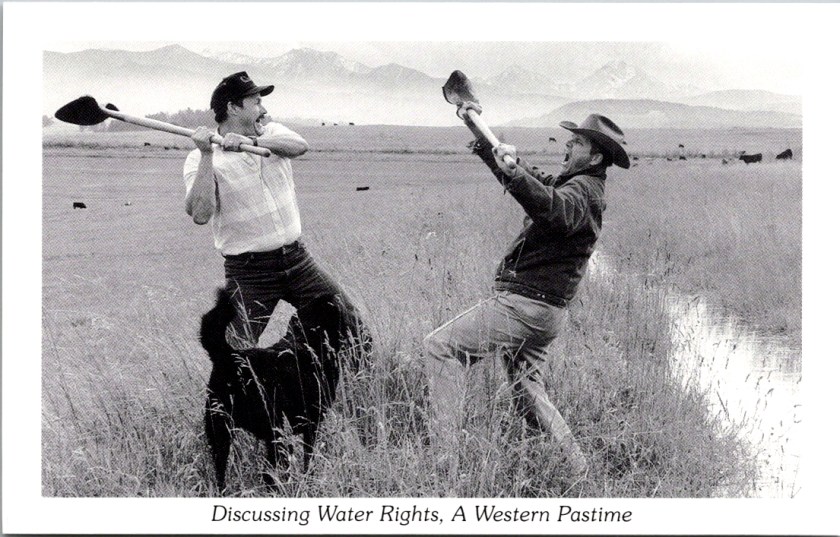
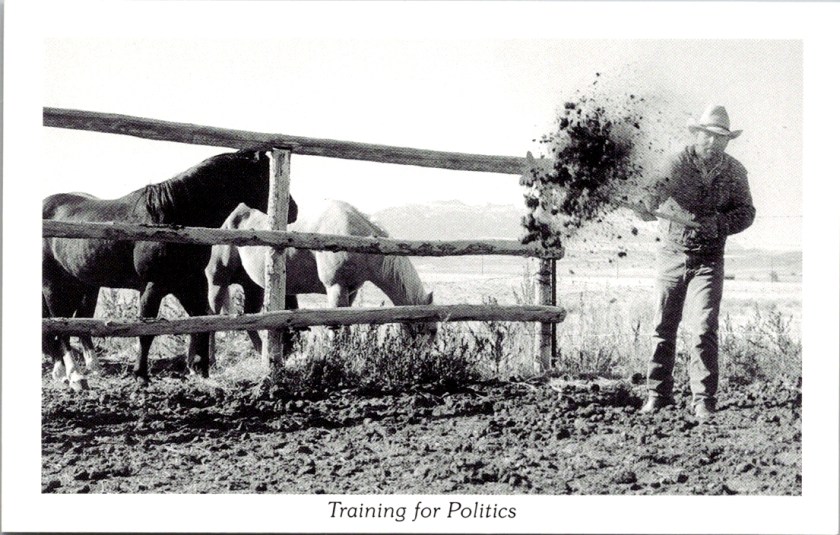
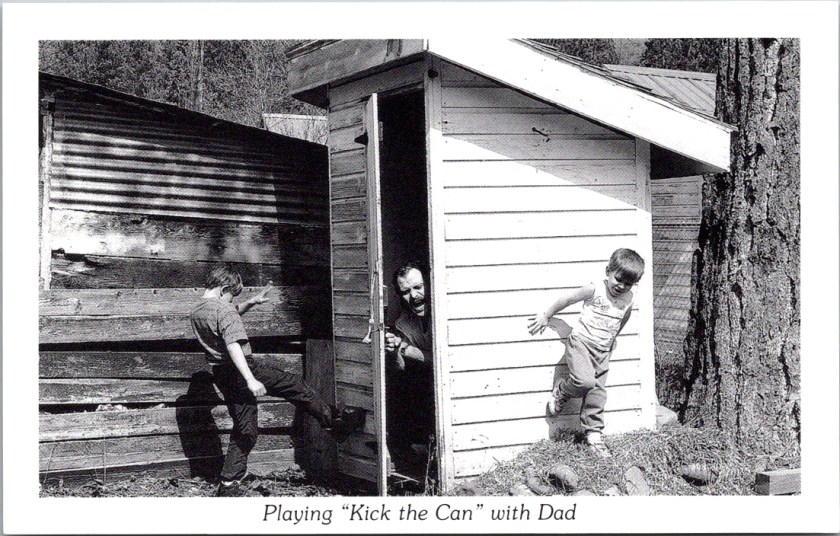
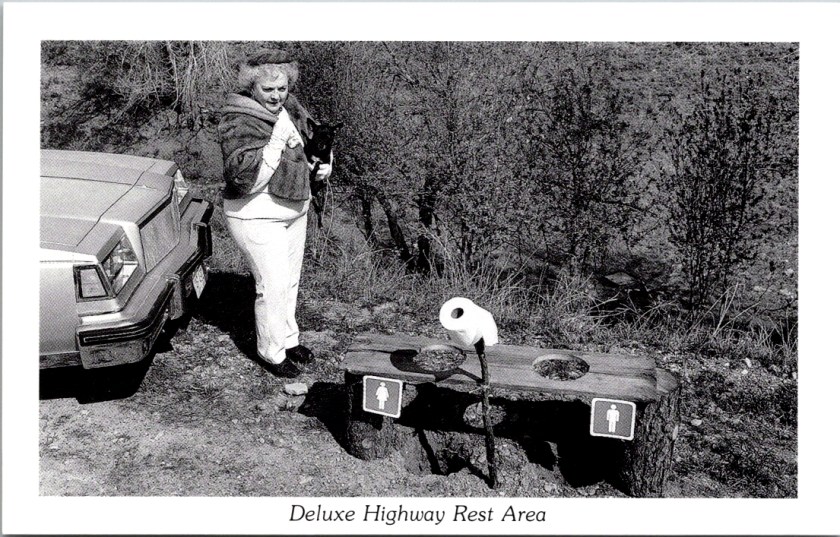
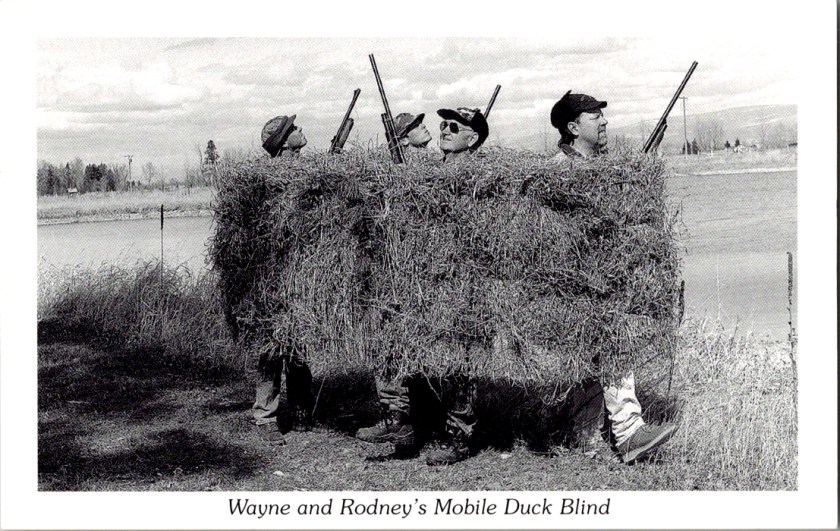
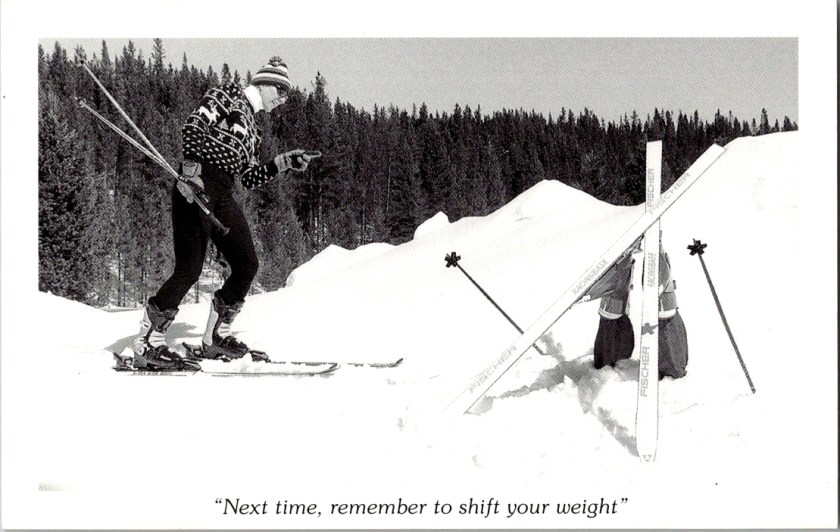
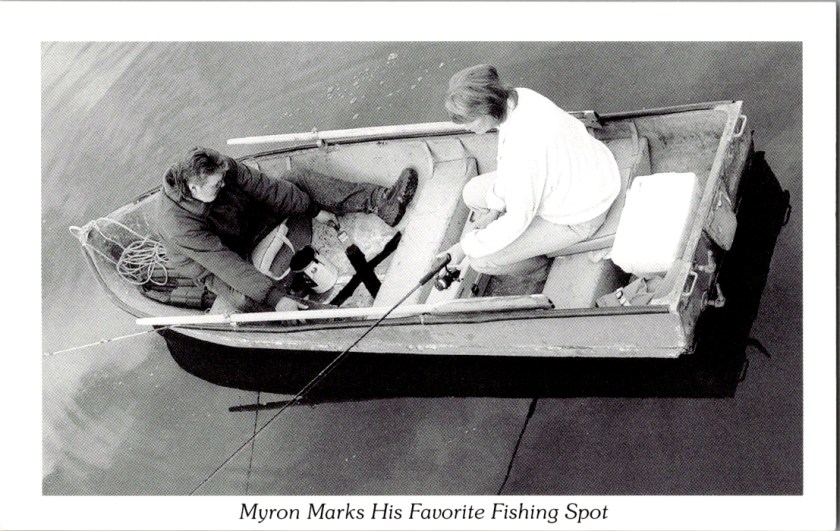
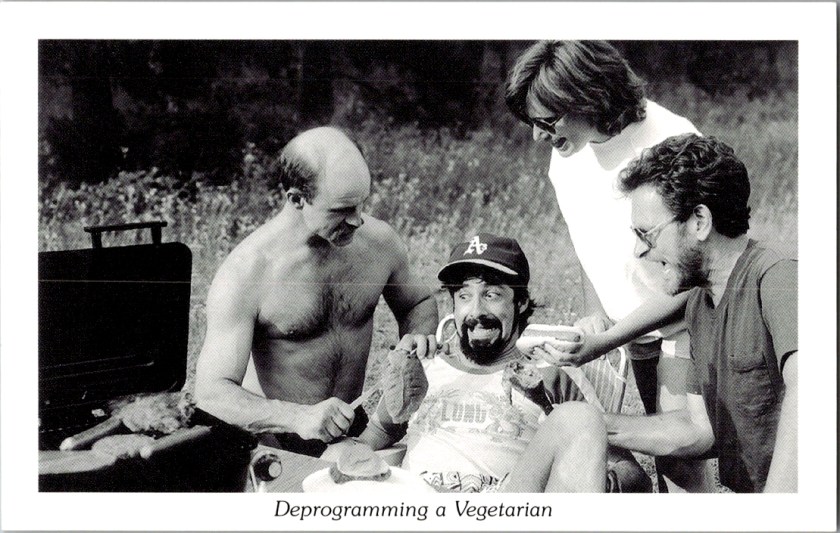
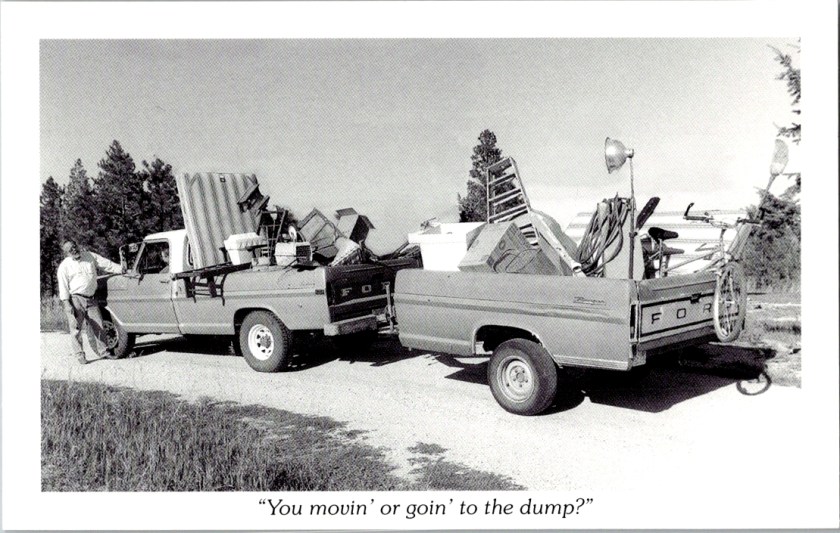
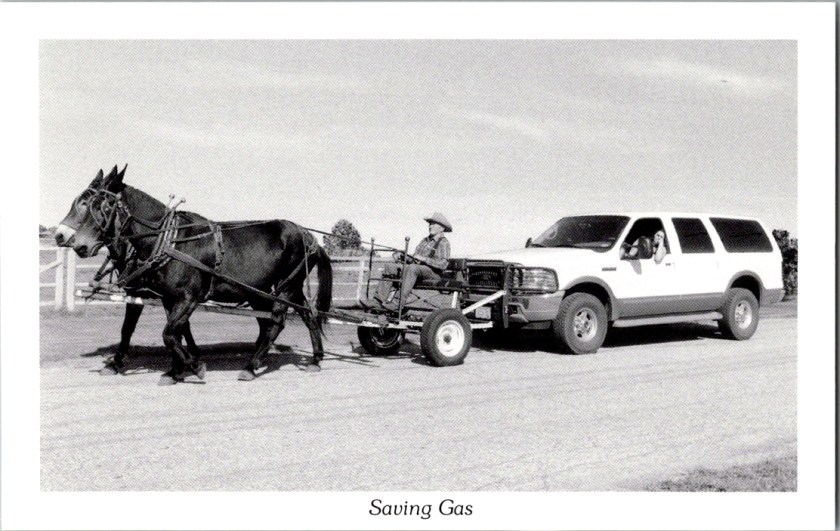
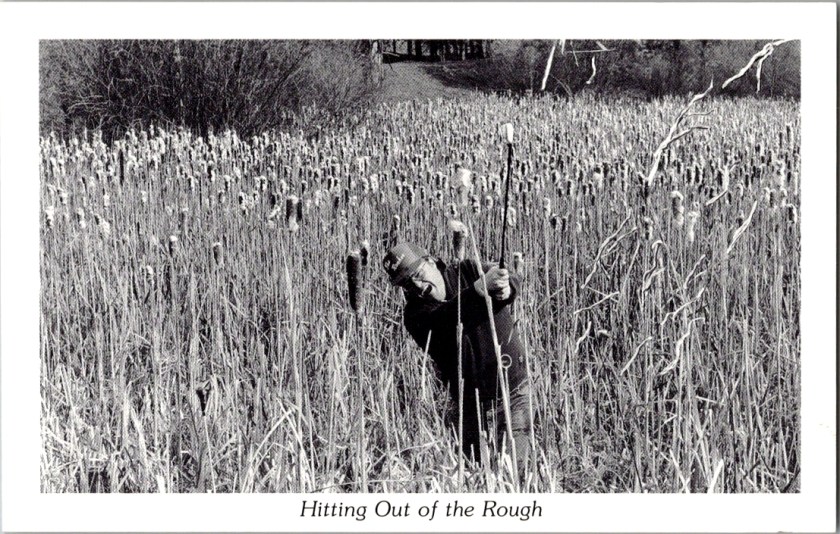
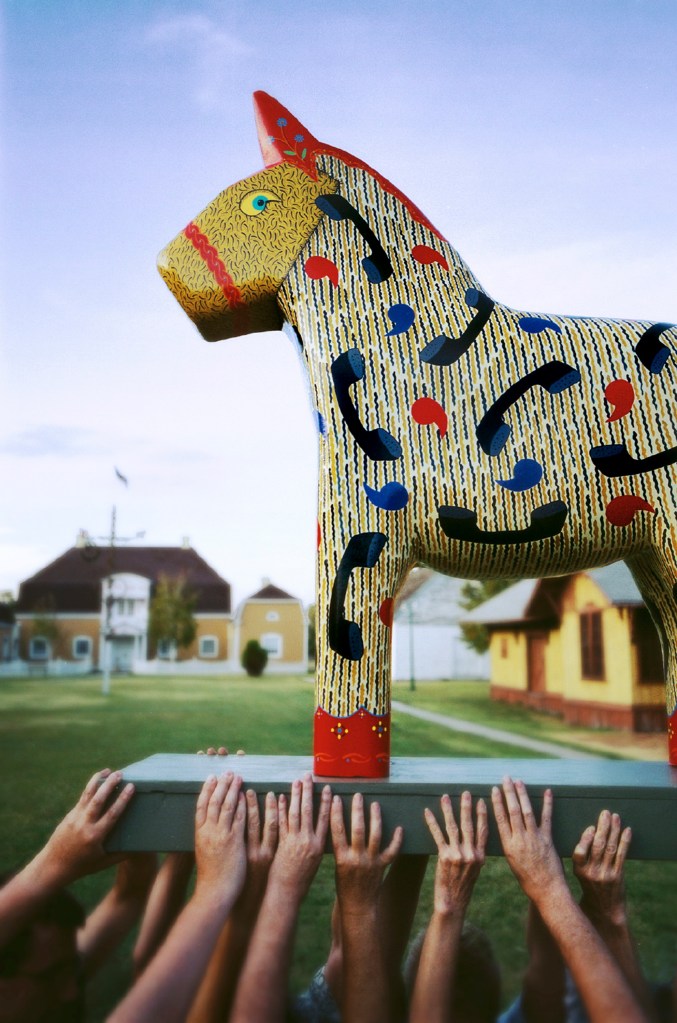
Let’s not forget all the fun in foolishness. Duckboy Cards gave us these guffaws from Hamilton Montana in the late 20th century.

In the Tarot, the Fool is the zero card, about to step off a cliff with a small satchel. The Fool’s journey is curious, flexible, and nonlinear, akin to the Buddhist beginner’s mind with the great powers of not-knowing.

The disciple Paul wrote that followers were fools for Christ, who knew that worldly measures were the real absurdities. Yurodivye, the holy fool in Russian Orthodox culture, courted ridicule and apparent madness as a form of spiritual freedom.

The Feast of Fools, celebrated across Europe in medieval centuries, inverted the church hierarchy for a day. Junior clergy elected a mock bishop and sacred ritual was gently parodied. The highest were made low for a day. The Church tolerated it for centuries, perhaps because it understood the release it provided.

In each of these traditions, foolishness is not failure. The Fool observes with a keen eye, collects information and assets, plays his cards carefully, and keeps his palm open.

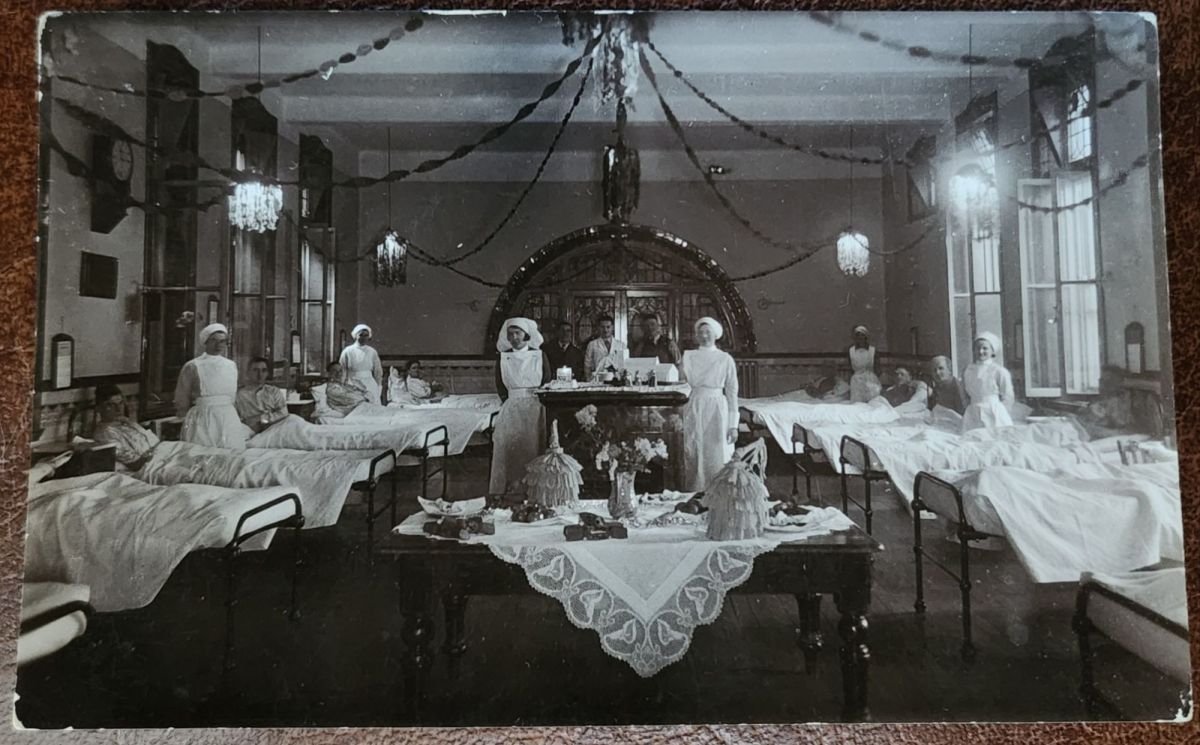
Just such a jester has been riding alongside us this season. In Lucky Us, we find that only a fool pursues luck outright. In Spring Cleaning, earth itself foolishly hopes despite all evidence of winter. In Healing Ward, nurses stringing crepe paper garlands for a room full of wounded men, and show us the beautiful absurdity of insisting on Christmas.

My thanks to you fellow fools who keep reading. Only you know why!

To Read More

Shakespeare’s Fools — All the fools’ best lines from the Folger Library

Picasso’s Rose Period — From 1904–1906, Picasso absorbed French culture in warm pink and orange light

The Feast of Fools — A matter of great Catholic controversy still

The Tarot Fool — The British Museum’s collection of vintage Tarot cards

April Fool’s Day — Museum of Hoaxes theorizes the origins of the holiday

Healing Ward

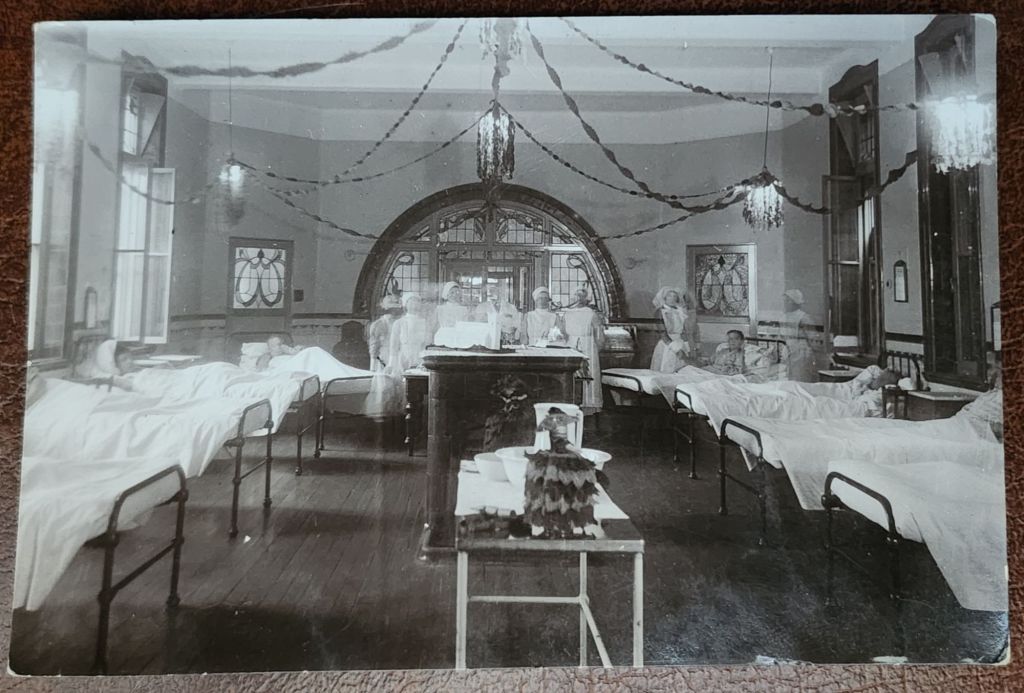
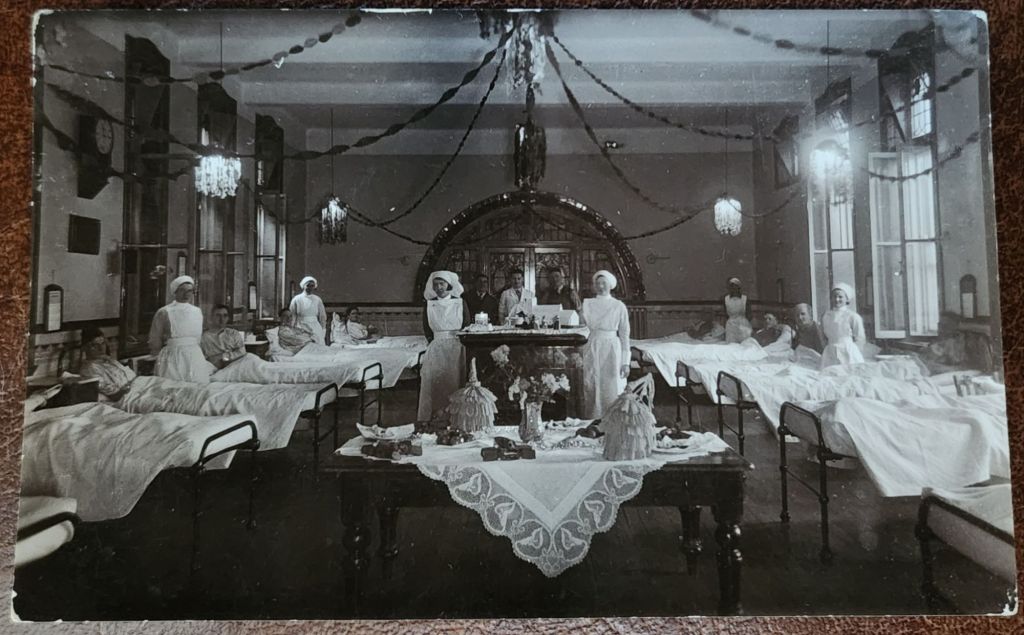
British WWI Hospital Ward RPPCs, a rare paired set, circa 1915–1918

These two real photo postcards document a British auxiliary hospital ward decorated for Christmas, sometime between 1915 and 1918. They are unused and in remarkably good condition. Together they form a matched pair, shot on the same day from opposite ends of the same large convalescence hall.

The architecture, nursing uniforms, iron bed frames, style of celebration, and the back of the cards all point to the same conclusion: a British ward during wartime Christmas, shot by a local photographer working with the same technical materials and conditions as those documented in well-respected the Wellcome Collection in London.

Front of Postcards

The room is large with high ceilings and tall windows running along both sides. Hardwood floors extend the full length of the ward. Iron-framed hospital beds line each wall in neat rows, their white linens crisp and turned. A series of small tables anchor the center aisle, dressed with lace edges and set with tiered decorations, small ornamental figures, and floral arrangements. Crepe paper garlands radiate among the hanging fixtures from the center toward the walls. Nurses in white dresses, bibbed aprons, and distinctive white caps stand at intervals among the beds. Male patients rest in several of the beds or sit up for the photograph.

The first card was shot from one end of the room, looking toward a grand arched window fitted with ornate leaded stained glass and flanking panels in a geometric floral pattern. The second shot looks back the other direction toward an interior archway.

The photographic quality of both cards is high. The tonal range is continuous, with a fine grain and deeply resolved shadows. The nurses in the first image are grouped more loosely near the central table, and a ghostly motion blur in their figures suggests a longer exposure time. The second image is darker and the poses are more formal.

Back of Postcards

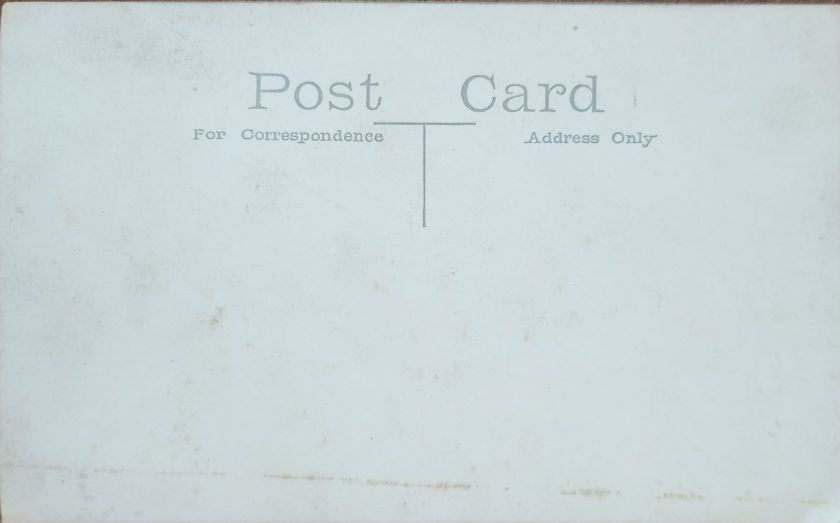
The cards share the same markings on the reverse, confirming they came from the same stock and photographer. The back carries the words “Post Card” in a decorative serif typeface, and a clean t-shaped dividing line delineating spaces “For Correspondence” and “Address Only.” No stamp box, printer’s imprint, paper manufacturer mark, or country or origin. That makes this RPPC irrefutably British.

Britain pioneered the divided postcard back in 1902, five years before the United States adopted the format. American RPPCs of the same era almost universally carried manufacturer’s marks such as AZO or VELOX in a printed stamp box, used to identify the photographic paper brand. British cards of this period carried no such mark. The back of these cards places their manufacture firmly in the British tradition.

The absence of any commercial marker further suggests a staff or commercial photographer and local production. These were not mass-produced. They were made in small numbers, likely for official wartime documentation or as personal mementos of a meaningful Christmas.

Two complementary long shots on a memorable day. Paired RPPCs are less common. A matched set intact, from a wartime context more than a century later, is rarer still.

Wartime Convalescence

Britain entered the First World War in August 1914 with 297 trained military nurses. Nowhere near enough for what was coming. Within weeks, the Royal Army Medical Corps and the British Red Cross Society jointly activated the Voluntary Aid Detachment system, mobilizing thousands of civilian volunteers to staff a network of auxiliary hospitals across the country. By 1918, approximately 80,000 VAD members served in uniform. Twelve thousand worked directly in military hospitals. Sixty thousand staffed auxiliary hospitals of various kinds.

The buildings pressed into service ranged from country houses and public schools to civic halls and converted warehouses. The ward in these cards show Gothic Revival arched windows with Arts and Crafts stained glass. The architecture is distinguished with high ceilings and dark wood wainscoting. Perhaps this is a purpose-built civic or private building of Edwardian ambition, converted for wartime use.

The iron bed frames visible in these cards match the tubular iron hospital beds documented in the ward photographs of King George Hospital, the largest military hospital in Britain during the war. Converted from a newly built HM Stationery Office warehouse on Stamford Street, London, the hospital opened in May 1915 and treated some 71,000 men before closing in June 1919. The Wellcome Collection holds its ward photographs. They show the same head and foot rail design, the same lightweight iron construction, the same configuration of beds along the ward walls. This was standard British military hospital specification, and these cards meet it exactly.

Wartime Wardrobe

We can more precisely date these cards by the white caps worn by the nurses. By early 1915, untrained VAD nursing staff had begun adopting the triangular floating veil worn by trained military nurses. Professional nurses were already unhappy about working alongside civilian volunteers. By November 1915, the Joint War Committee introduced a standardized cap for VAD nurses, making distinctions of training and rank visible at a glance.

The caps in these cards match that post-1915 VAD style. They are not the earlier flat cap prior to 1915, nor the fully structured veil of the trained QAIMNS sister. The confidence of the nurses’ poses and the scale of the ward celebration suggest an established wartime routine rather than the improvised urgency of the war’s first Christmas. This may narrow the date to 1916, 1917, or 1918.

Wellcome’s Wartime Collection

The Wellcome Collection’s photographic holdings of The King George Hospital archives open a window onto wartime convalescence. From the start, its philosophy held that recovery from war’s trauma demanded more than medicine.

Each bed had an electric light and a pink and white quilt. Common rooms on each floor were set up for socializing, smoking, reading, and writing letters. A miniature Harrods-like gift shop kept the wards stocked with comforts to necessities. It ordered up to 60,000 cigarettes each week so every patient could have six or seven smokes a day.

Most remarkably, a Royal Academician designed a rooftop garden that eventually held 24 revolving shelters positioned so patients could take in the air and watch the River Thames in all weathers. Queen Alexandra visited in May 1915, and that September she sent the hospital a tripod telescope so patients could study the rooftop view across London. On Christmas Day 1916, King George V and Queen Mary toured every ward in person, and presented each patient with a copy of the Queen’s Gift Book.

The decorated ward in these postcards belongs to that same time period, patriotic conviction, and palliative approach. The lace tablecloth, tiered cake stands, crepe paper garlands, and nurses standing at attention in their best uniforms were elements of organized care for men who had survived the Western Front, deserved a memorable Christmas, and needed more than the doctor’s orders.


To Read More

First World War photographs of military hospital at the Wellcome Collection.

History of King George Hospital at Lost Hospitals of London

Scarlet Finders research on VAD uniform dating guide

The British Red Cross and auxiliary hospitals during the First World War

Historic Hospitals on the broader history of auxiliary hospital use

Detailed guide to British military nursing services during the Great War

Spring Cleaning

A path appears underfoot every year around this time, with a slight softening of the ground and a change in the light. The road is old, but the way is new again.

Spring equinox arrives in just a few days, another moment when day and night stand in perfect balance. Nowruz, one of the world’s oldest celebrations, falls on the equinox itself, marking the moment the earth turns toward renewal. Observed for at least three thousand years across Persia, Central Asia, the Caucasus, and the diaspora communities that carry it around the world, Nowruz means new day and it begins precisely at the moment of the spring equinox.

Preparations are meticulous. The house is cleaned from top to bottom in a practice called khane-tekani, shaking out the house, to release the accumulated weight of winter. A ceremonial table is set with sprouted wheat for rebirth, vinegar for patience, garlic for health, and a goldfish in a bowl for life against all odds.

In Chinese Lunar New Year, it is the year of the horse. All the teachings of Ramadan have been quietly observed this month. Christians are entering the heart of Lent, when liturgical colors shift from penitential purple to radiant rose, and the invitation is to rejoice. World traditions share this central wisdom. To walk forward, one must first prepare.

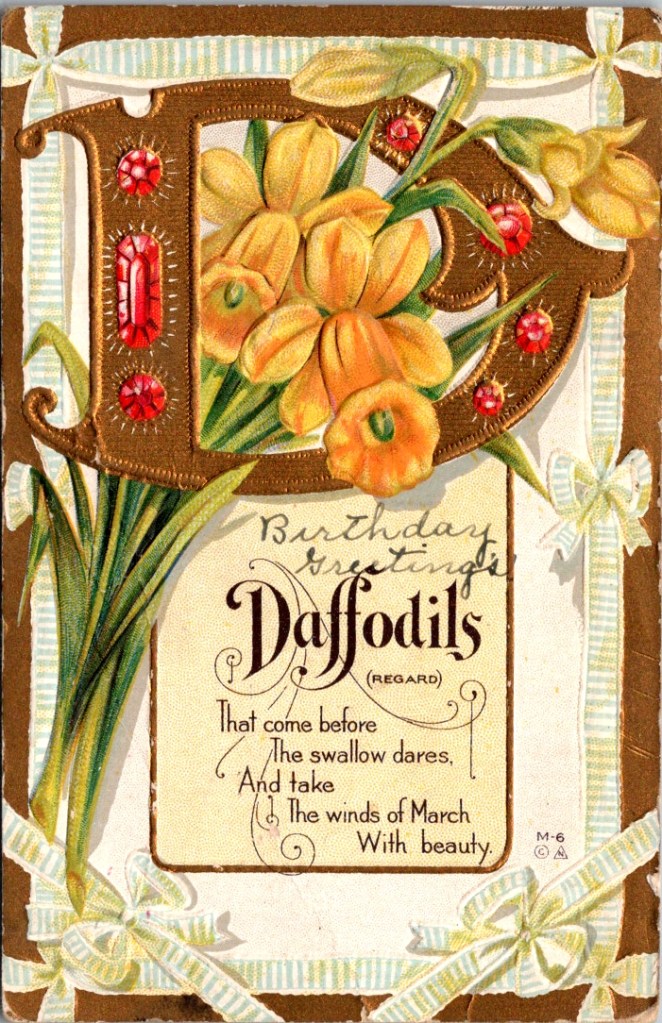
This morning my path runs along Sligo Creek near Washington DC, where the trail follows the water through an old urban forest. The snowdrops are done. Small and white and brave, they came and went in February. Crocuses are finishing now, purple and yellow scattered through the leaf litter. Daffodils line the path in both directions to proclaim the news of spring. Soon the cherry blossoms will arrive, carrying the Japanese mono no aware, bittersweet awareness as beautiful things pass.

For the next few weeks I’ll be traveling. Away from my desk and the collection. Being in motion feels at pace with the season. By early April I’ll be back in Arizona, where spring doesn’t linger the way it does in the East. The desert has its own brief, vivid version of the season. Sharp early light and cool mornings, palo verdes going yellow and the brittlebush blazing.

For me, it’s a time to toss off the heavy winter blankets, move furniture, dust out the corners, and feel all the motivations of the season. The Posted Past is making some new moves, too.

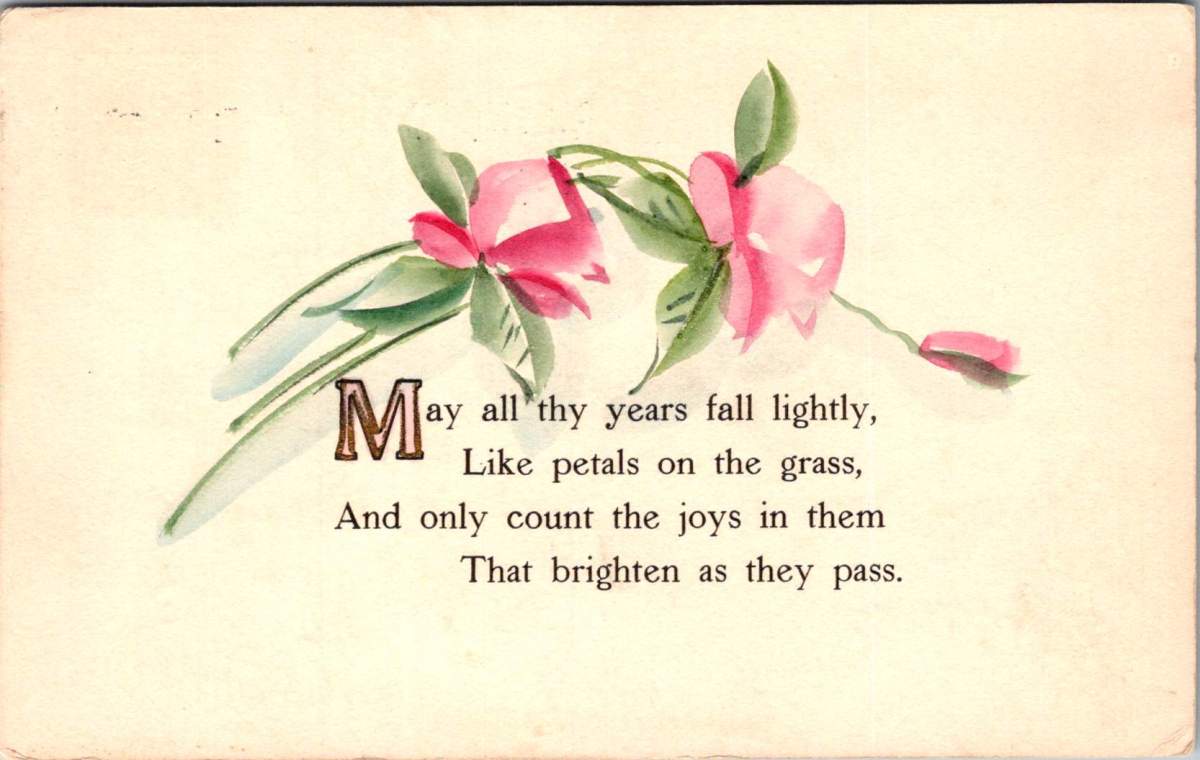
Spring greeting cards are full of flowers and fancy, and the messages give us gentle permission to start again. If you are grass-side up, count yourself among the living and the hopeful. Believe that what comes next might be better.

Take a walk this week, if you can. Clear an old task you’ve been putting off. Set the table. Notice what’s arising in your life. Greet the new day.

Lucky Us

Romans advised that fortune favors the bold. In Sweden, luck never gives, it only lends. In the United States, the harder you work, the luckier you get. The Arabic proverb says, “Throw a lucky man into the sea and he’ll come up with a fish in his mouth.” A Brit might be lucky at cards, unlucky in love. In Japan, the day you decide to act is your lucky day. 

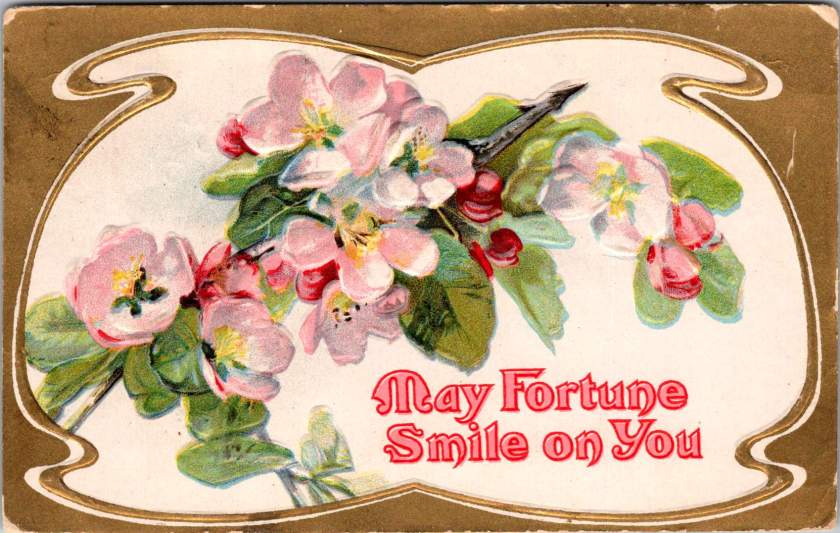
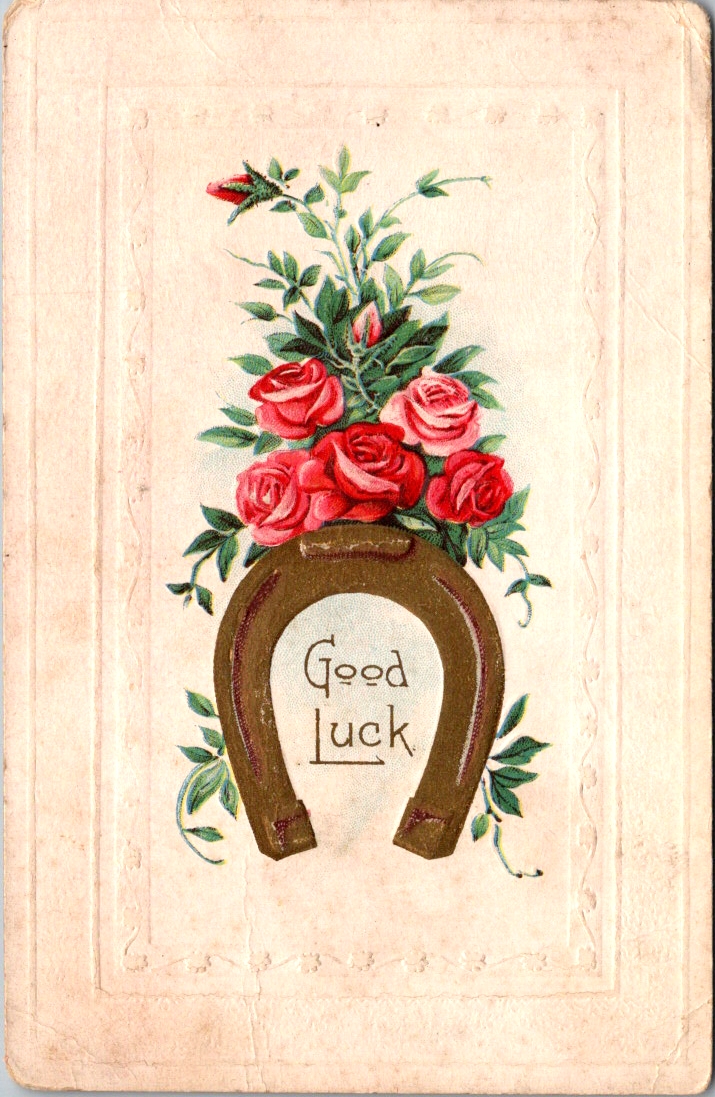
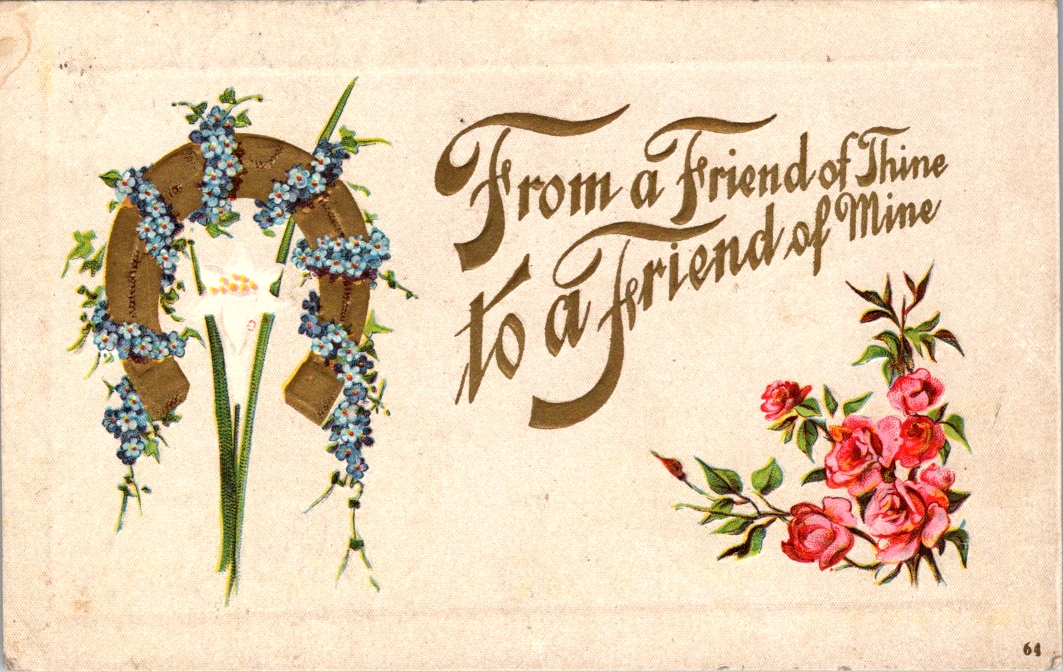
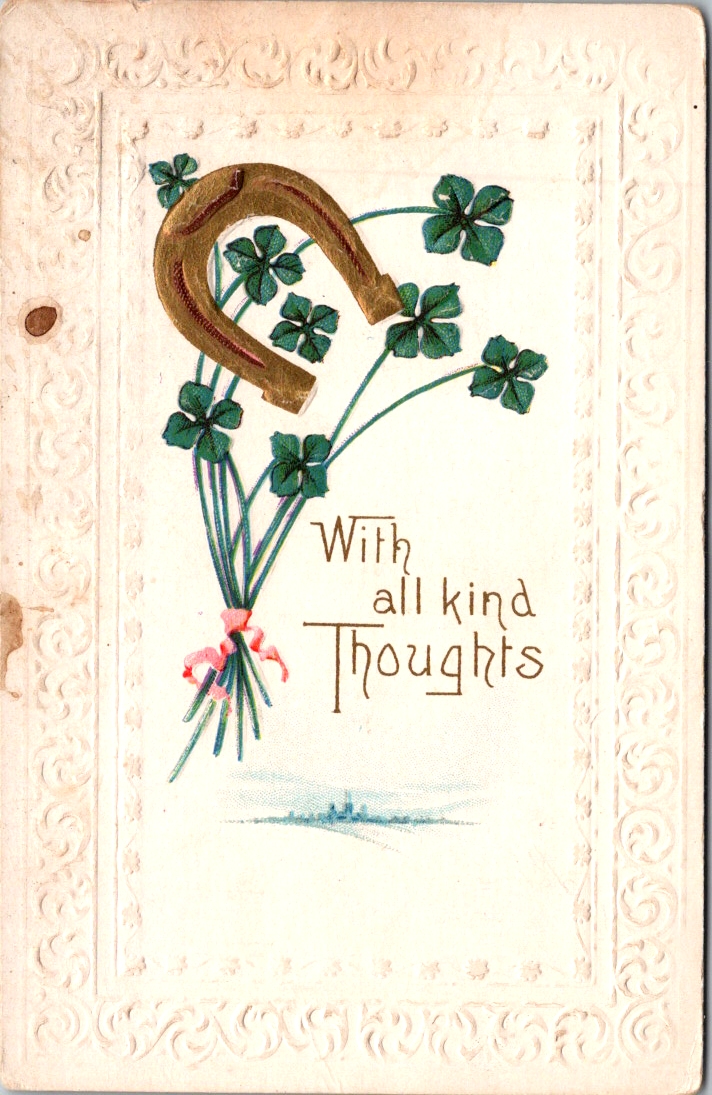
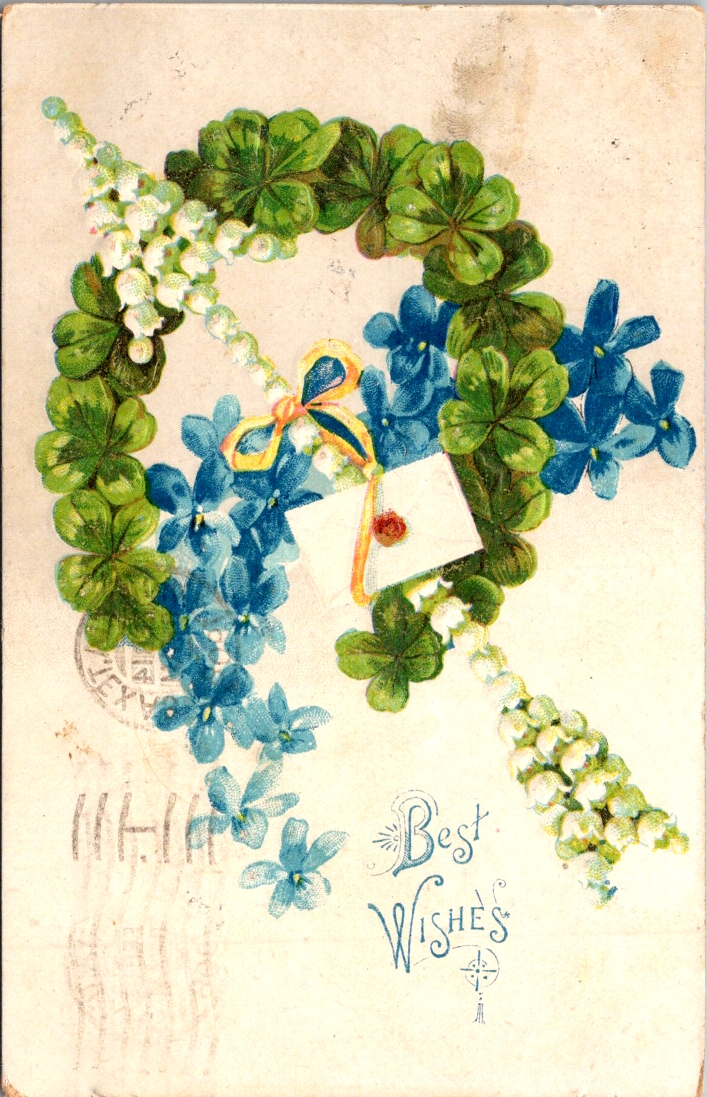
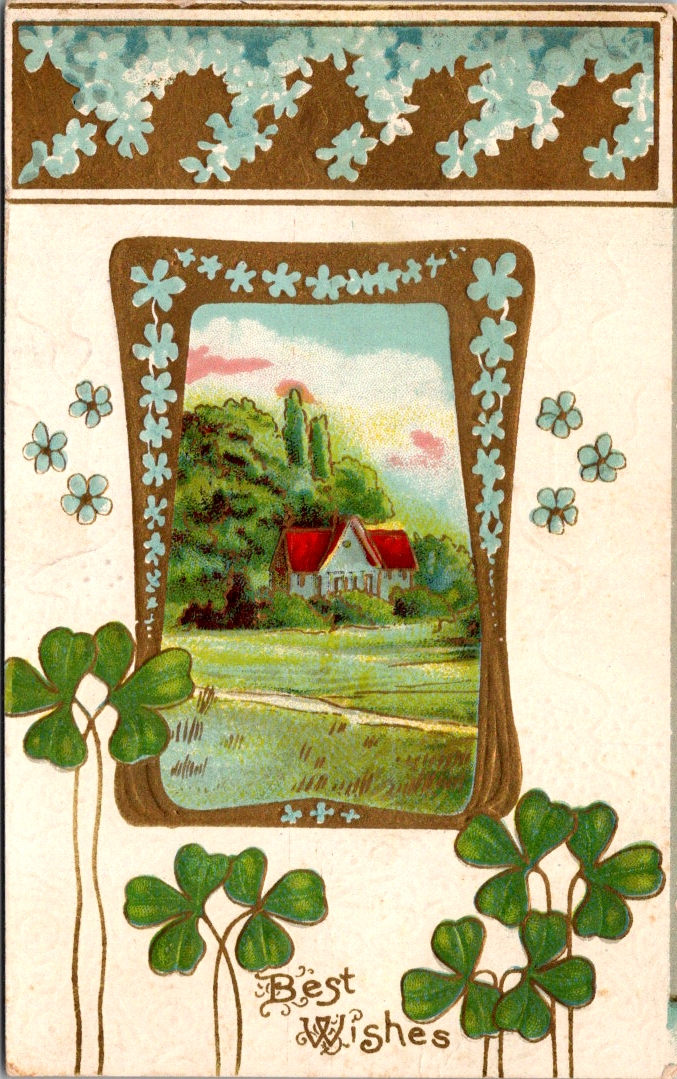
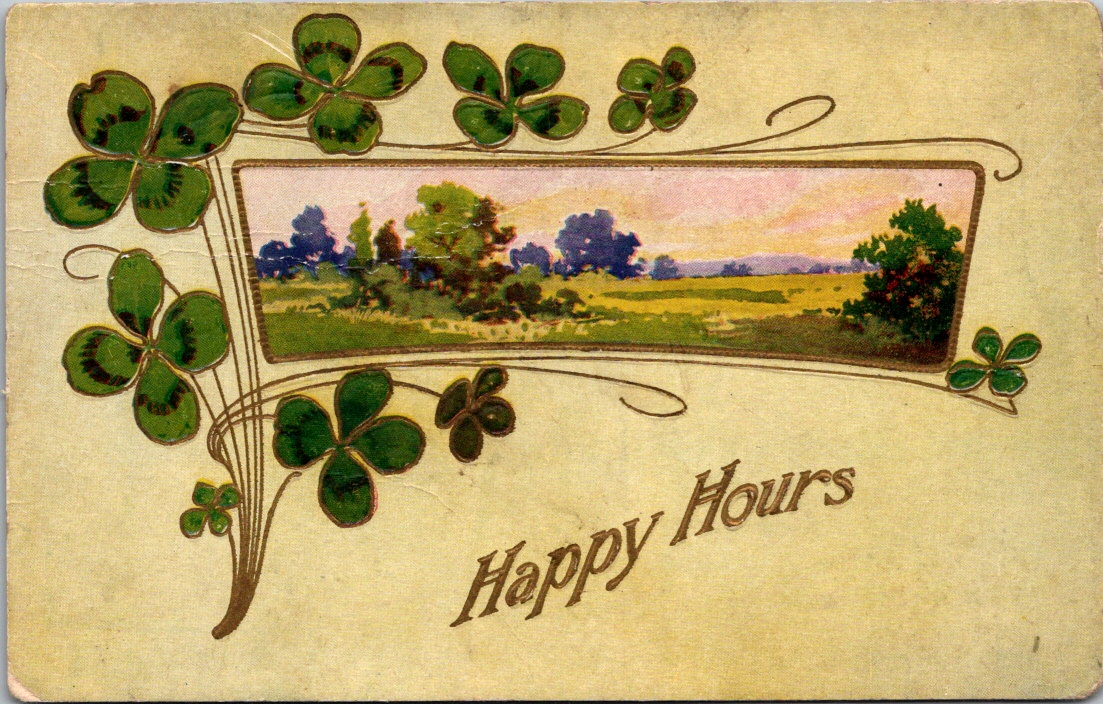
Edwardian postcards had a curious set of symbols to call forth fate and fortune. Horseshoes, shamrocks, roses, and playing cards. Small and slightly worn at the edges, these vintage greeting postcards have traveled more than a century carrying a providential wish.

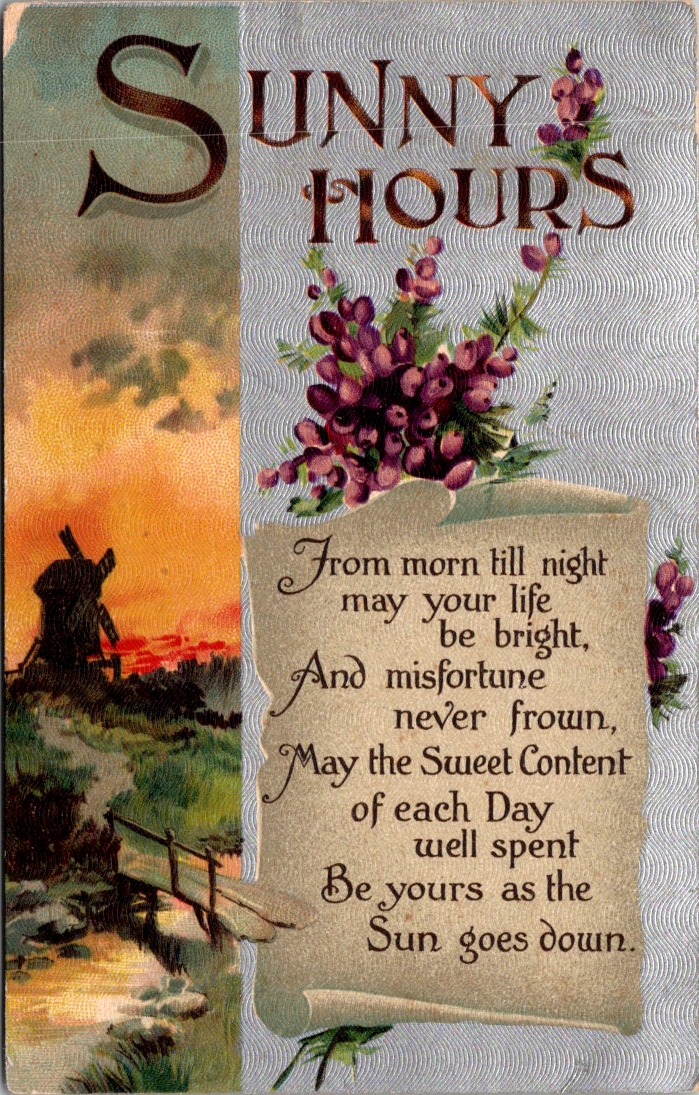
Only one card in the collection actually says Good Luck. The rest offer best wishes, happy hours, and kind thoughts from me to you. As we’ll see, luck is borne of relationships (and circumstances) lifted by the charitable wish for health, wealth, and wisdom.

Some say that luck can be earned, but only a fool pursues it outright. We daydream about what fortunes may be in store, and sometimes ignore the simple sparkles that appear each day. We know, of course, that there are no free lunches. Yet, we are admonished to never look a gift horse in the mouth.

The bold assume they earned their lucky breaks. The humble suspect they’ve borrowed fortune temporarily. The superstitious are not entirely sure we should discuss it. Luck is where fate and intent find common cause, usually in the context of close friendships.

Old English had no luck. It used wyrd instead, which pointed to fate and destiny. Wyrd is the root of our word weird, which may indicate how people felt about fate. It was uncanny, inevitable, and perhaps divine. You didn’t pursue wyrd. You experienced it through awe and fear.

Somewhere around the 15th century, luk and gelucke drifted in from the Dutch and Low German. Luck was looser and more manual. Like weather, luck favored preparation and was possible to influence if you knew the right charms. The horseshoe went up above the door. The rock went in your pocket. If luck is not fate, if it is not fixed in advance, then perhaps you can do something about it. Perhaps it can be courted.

The lucky person is not the one who waits but the one who steps into the room. This is luck as a reward for courage, or at least for motion. Fate deals the cards, and we each have a hand to play.

Fortune favors the bold — fortes fortuna adiuvat
~ Terence, Roman playwright, around 151 BCE

Luck is what happens when preparation meets opportunity, and preparation is something you control. The solo pursuit of fortune is a genuine drive.

The harder I work, the luckier I get.
~ Samuel Goldwyn

But the shamrock gently disagrees. Four-leaf clovers are natural anomalies, not personal achievements. We can’t earn one, only discover it. Even if you can court luck, even if work and boldness can pull it toward you, it is never yours to fully command.

Luck never gives; it only lends.
~ Swedish proverb

Some people simply have it, inexplicably, in ways that have nothing to do with preparation or boldness or a rabbit’s foot.

Throw a lucky man into the sea, and he will come up with a fish in his mouth.
~ Arabic proverb

Some observe that luck is a finite resource and can be unwisely traded away. This may or may not be true, but as a matter of human priority it is clarifying. We each get chances to test our luck.

Lucky at cards, unlucky in love.
~ English proverb

The tension between fate and will, between earned luck and divine luck, is located in a moment of commitment. The lucky day is not the day something falls in your favor. It is the day you decide it might be worth the effort.

The day you decide to do it is your lucky day.
~ Japanese proverb

Whatever the senders intended and however the recipients replied, these cards demonstrate how providential language holds us together in anticipation of something wonderful just ahead. The possibility that things might go our way.

The symbols of luck nested together in relationship, in abundance, in the living world — a horseshoe wreathed in flowers, overflowing with roses, or flanked by shamrocks — is not an accident of Victorian design sensibility. It draws on the ancient wisdom that friends are the true source of life’s lucky breaks. Love does the work and luck gets the credit.

Shakespearean Soap

In the 1880s, someone figured Shakespeare had the perfect verse for selling soap.

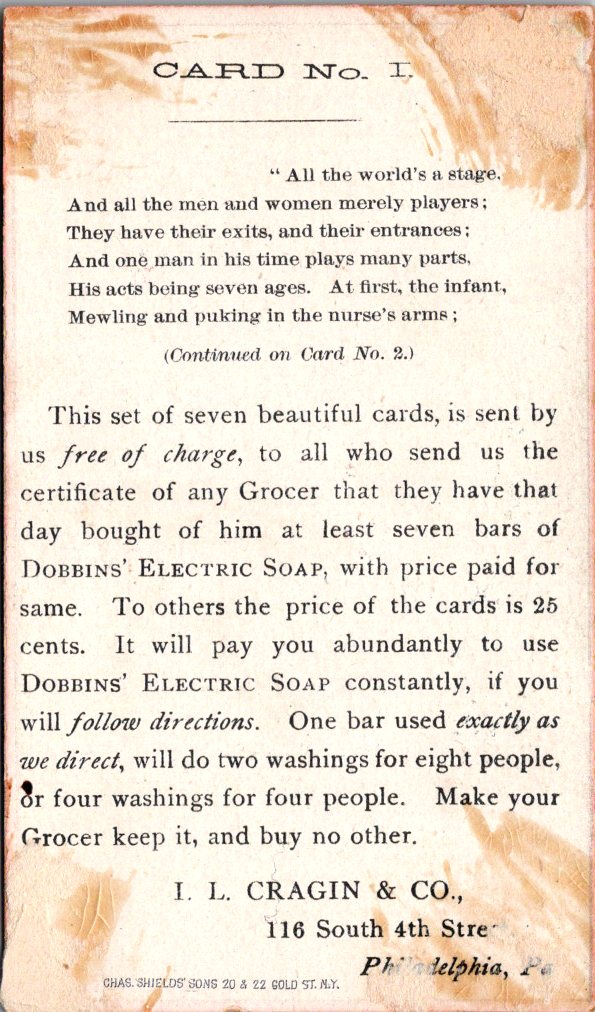
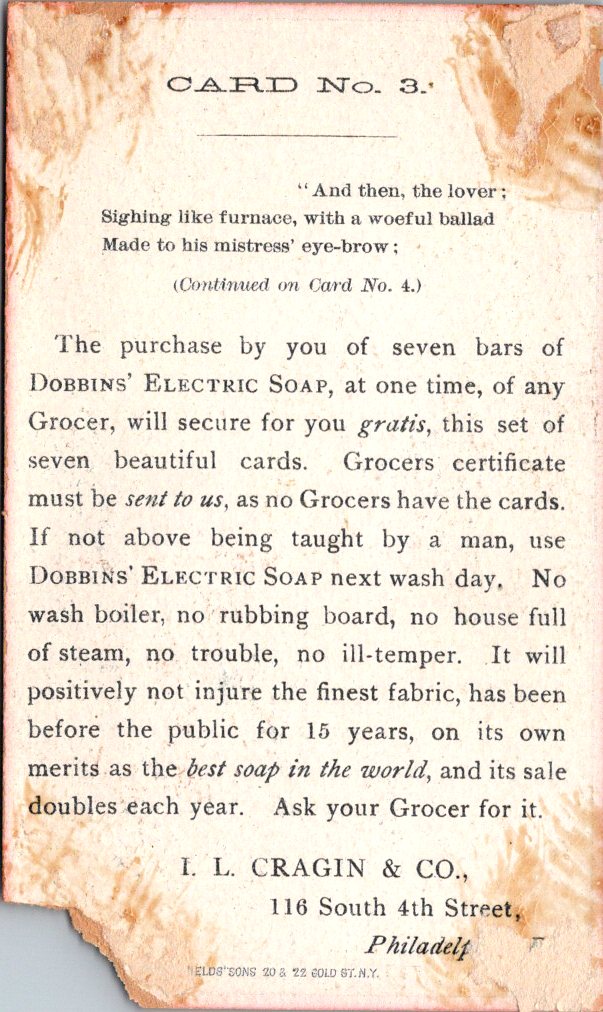
Rare Cards ~ Seven Victorian Trade Cards Selling Dobbins’ Electric Soap

In Shakespeare’s As You Like It, Jacques delivers his monologue in Act II, Scene VII, observing human life with world-weary detachment. He sketches out seven distinct chapters of a human life, from mewling infancy to toothless old age, with equal parts affection and irony. One of the most quoted passages in all of Shakespeare, by the 1880s it was deeply embedded in popular culture — the kind of verse that some households knew by heart.

“All the world’s a stage, and all the men and women merely players.”

Dobbins’ Electric Soap was manufactured by I. L. Cragin & Co. of Philadelphia and had been on the market since the mid-1860s. By the early 1880s, the company was advertising heavily through trade cards, chromolithographic collectibles that matched the indulgences of the Gilded Age. Cragin’s innovation was to produce not a single card but a series of seven that required the collector to buy a bar of soap each time. Get the certificate from your grocer, and the full set arrived by mail free of charge.

Philly, 1880s. Shakespeare meets laundry.

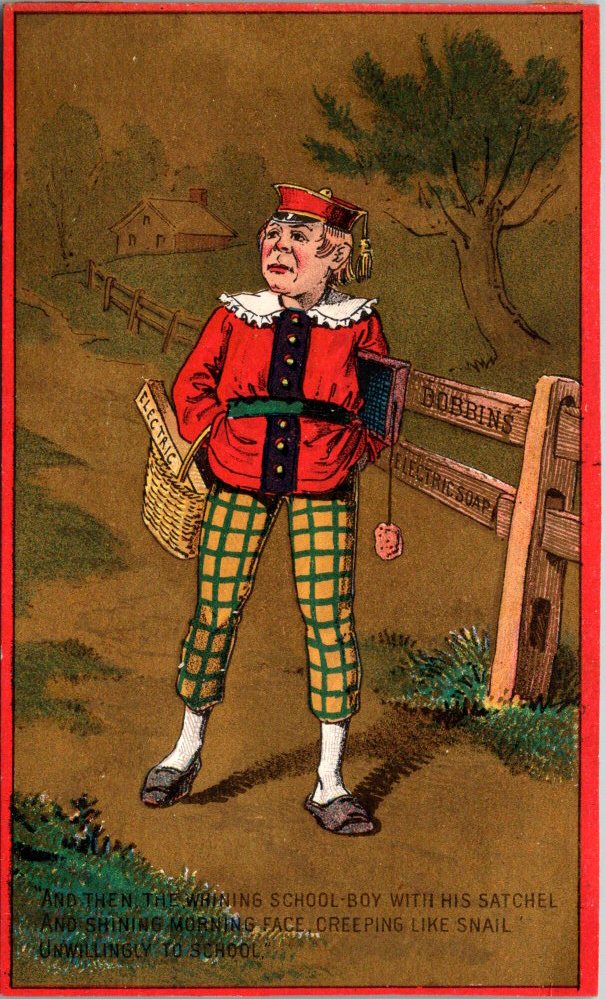
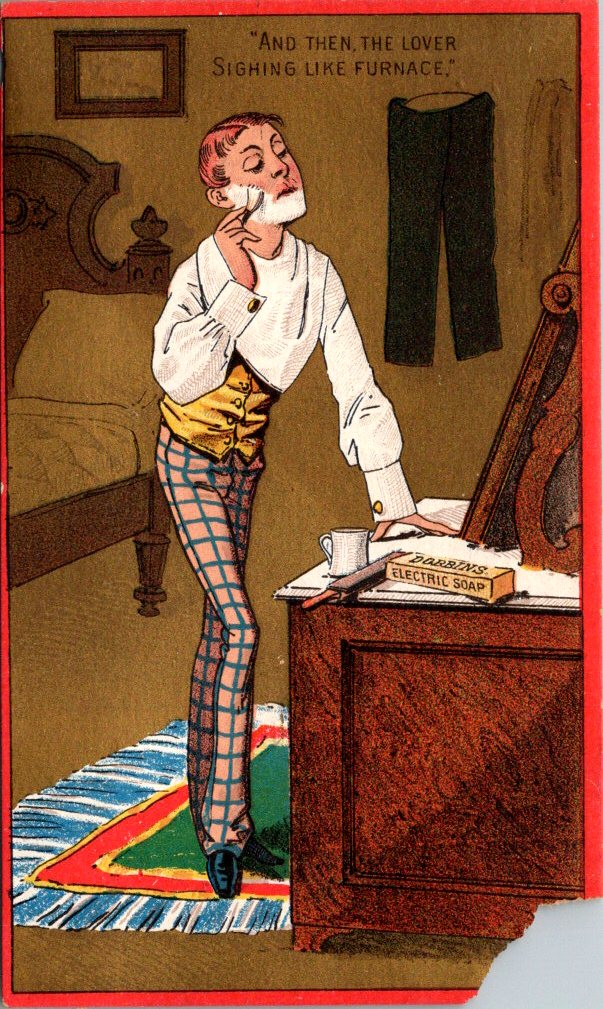
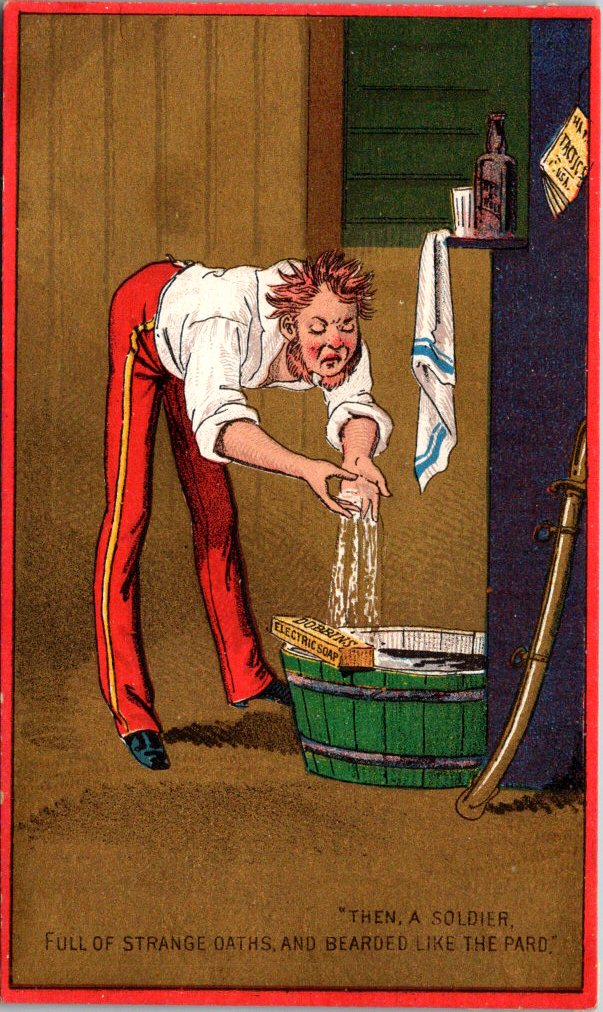
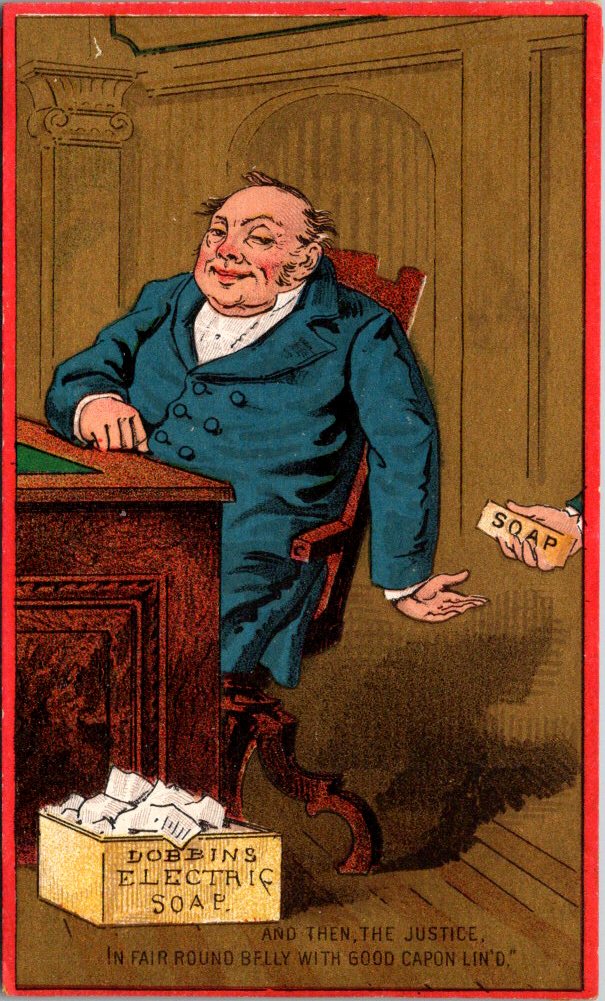
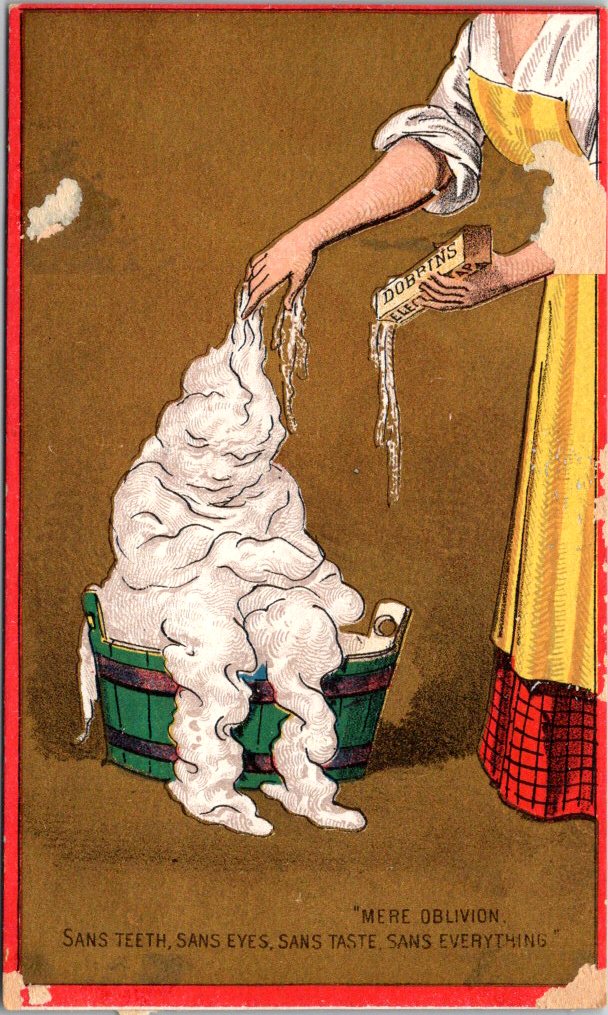
Front: Each card is a vivid chromolithograph on a warm gold ground with a bold red border, a consistent visual identity that makes the cards a set. The figures are drawn in a coarse comic style, expressive and exaggerated, with each character placed in a domestic or outdoor scene with a bar of Dobbins soap nearby.

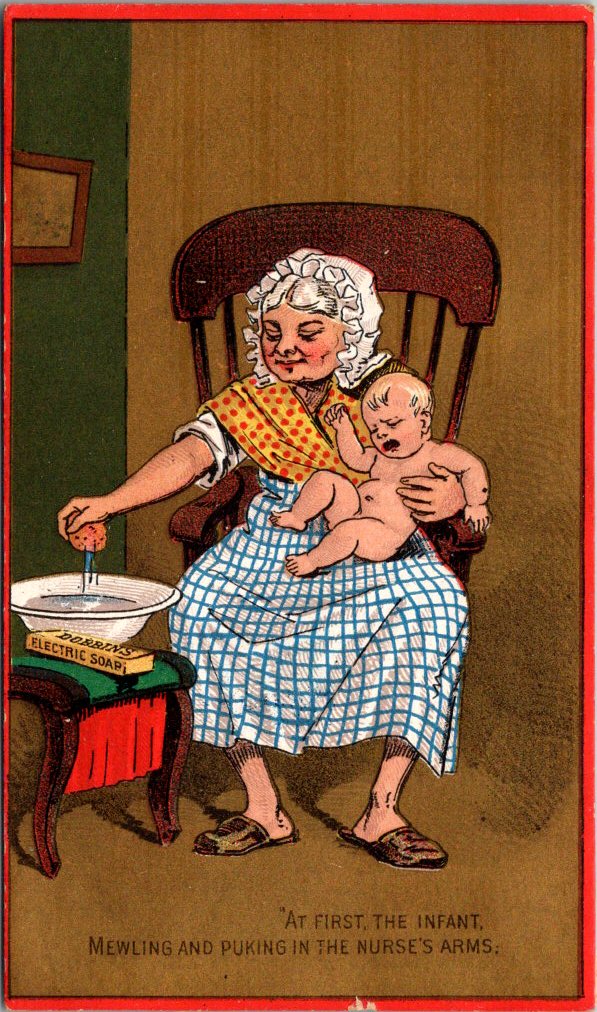
First, a round-faced nurse in a white mobcap seated in a rocking chair, holding a squirming naked infant over a washbasin. Card Two shows a sulky schoolboy in a red jacket and yellow-green plaid knickerbockers, satchel over one shoulder. The lover on Card Three is a lanky figure in a gold waistcoat and plaid trousers, leaning against a bureau in a disheveled bedroom.

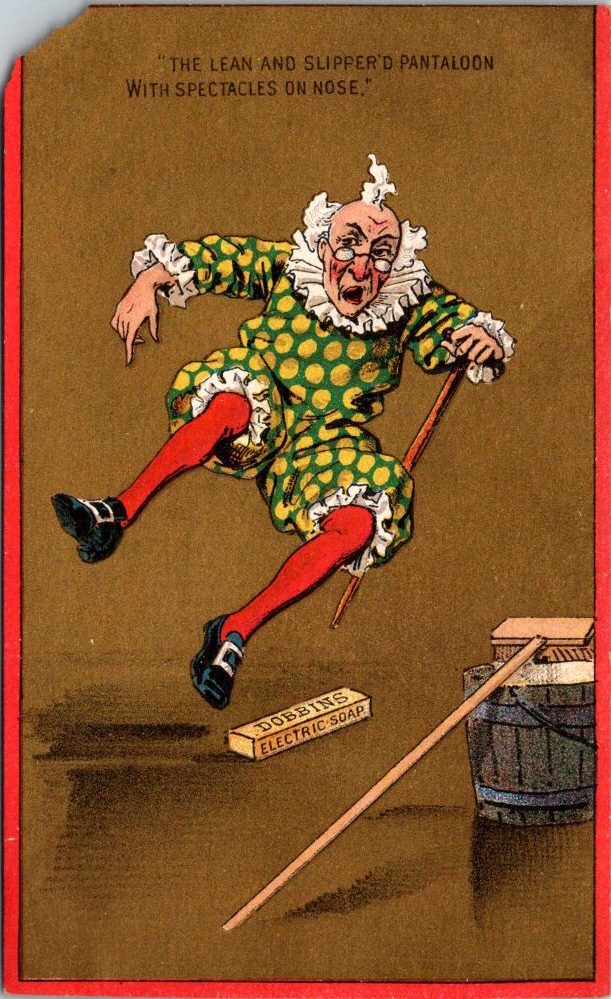
The soldier on Card Four is wild-haired and red-faced, bent over a green barrel-tub in his uniform trousers and braces, and a sword against the wall behind him. Card Five presents a rotund man in a blue coat, leaning back in his chair with the serene self-satisfaction of someone accustomed to receiving gifts. Card Six is an elderly Harlequin figure in a polka-dotted costume with red stockings, tumbling in mid-air. The final card is a woman in a yellow apron leaning over a green wooden tub, and a billowing human figure made entirely of suds.

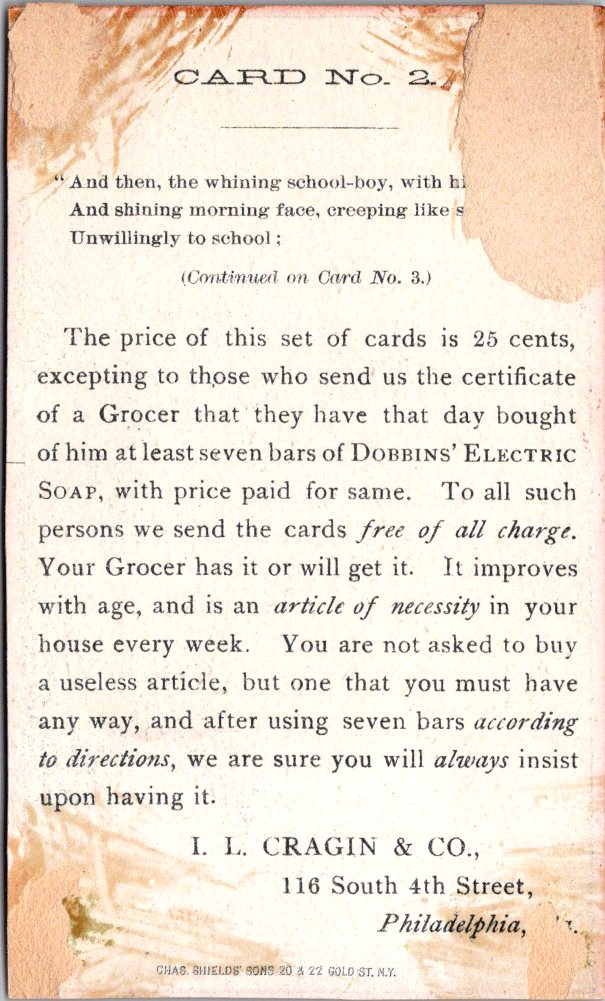
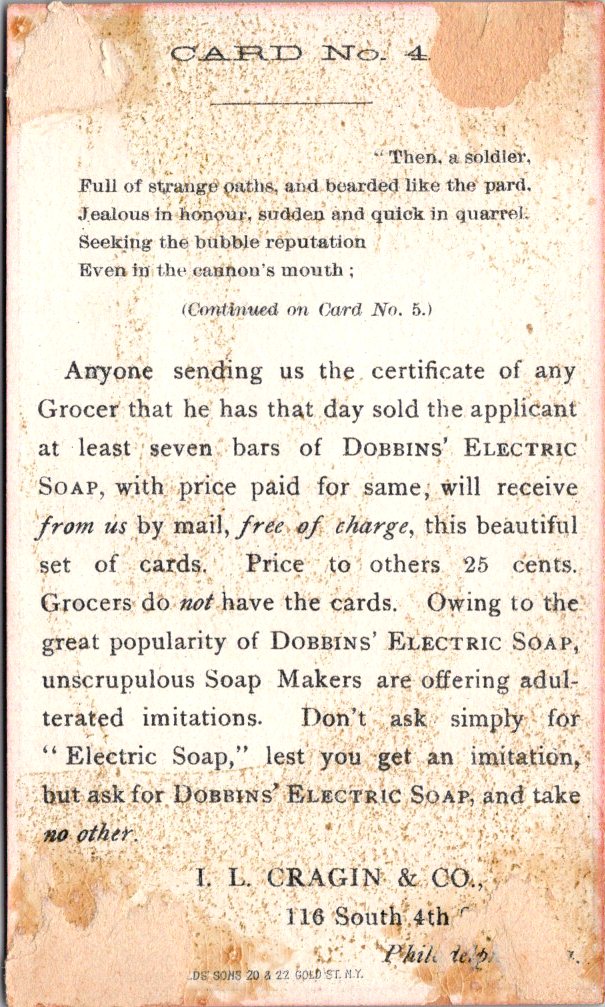
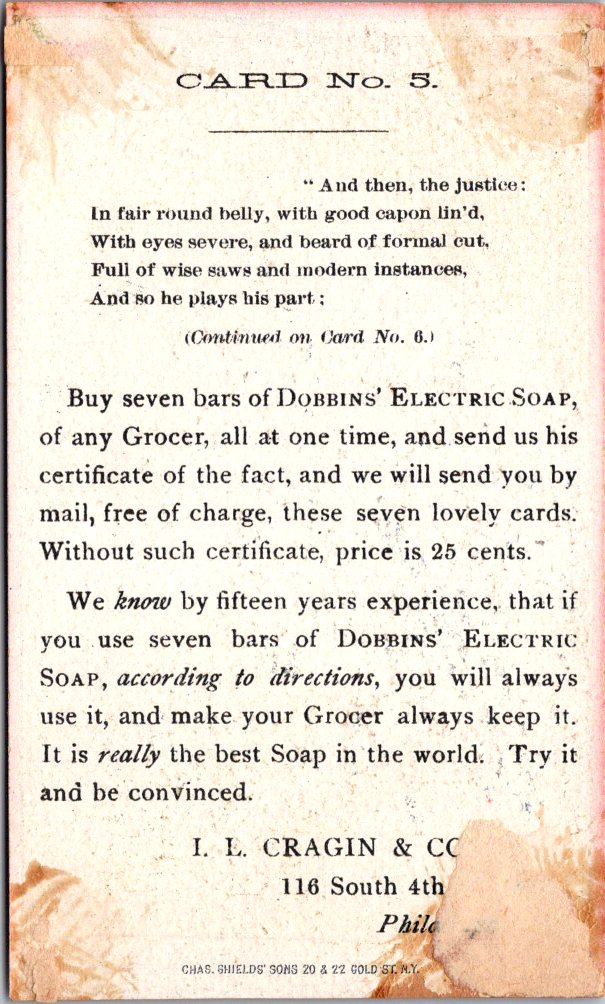
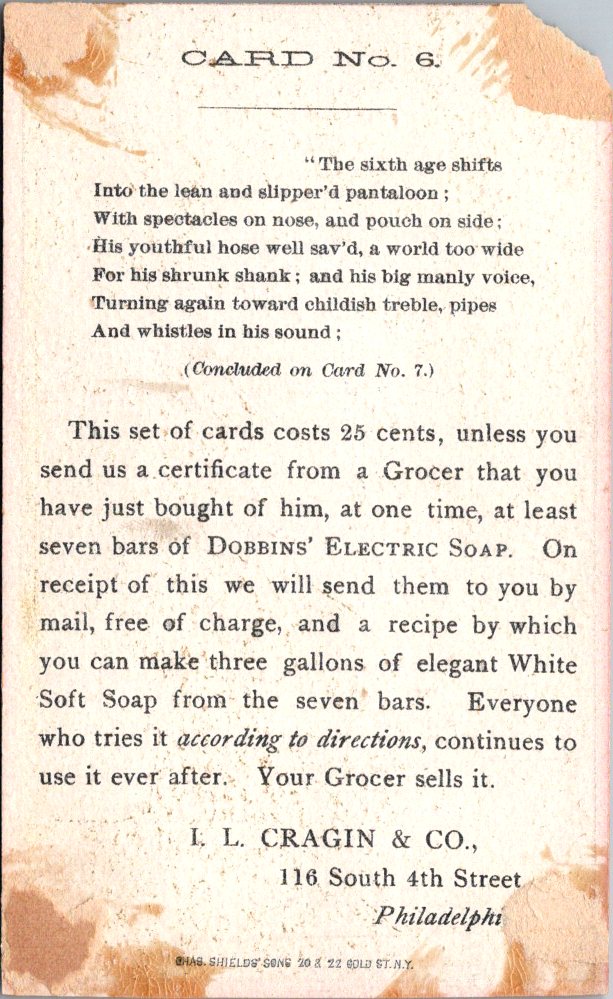
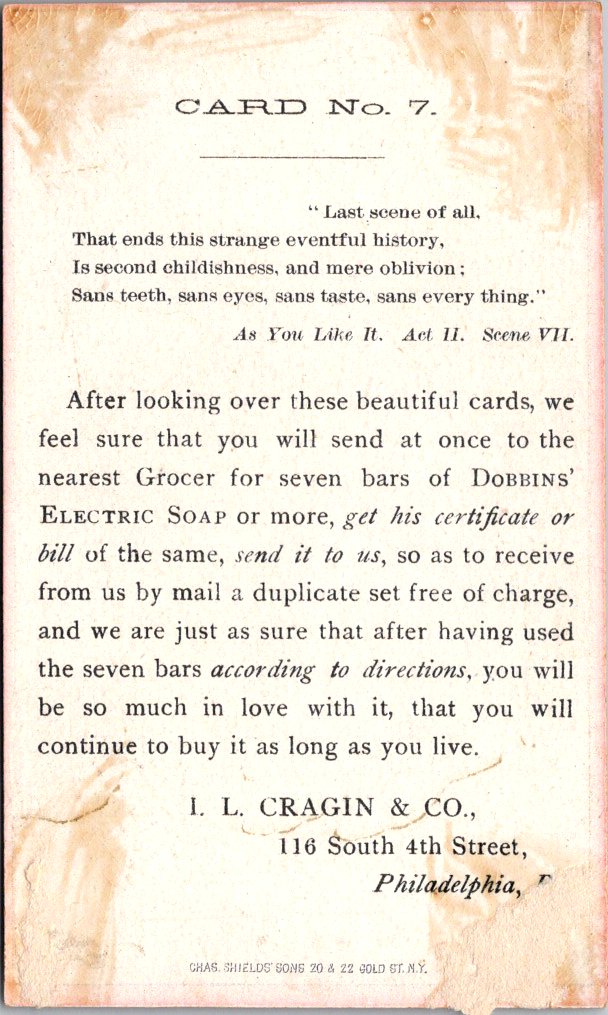
Reverse: Black text on cream stock with the full Shakespeare speech across all seven cards, each picking up the verse where the last left off. The final card identifies the source: As You Like It, Act II, Scene VII.

Below the verse, each card runs a version of the same offer in slightly varied language: collect a grocer’s certificate for each bar purchased and mail seven of them to 116 South 4th Street, Philadelphia. Without the certificate, the price for the set is 25 cents.

Each card presents a few product features: no wash boiler, no rubbing board, no house full of steam. Card Four warns against unscrupulous imitations and instructs buyers to ask for Dobbins’ Electric Soap by name. The printer’s imprint for Chas. Shields’ Sons, 20 & 22 Gold Street, New York appears at the foot of each reverse.

Production: These high-quality commercial chromolithographs likely date to the early 1880s, after the business had been in operation for more than a decade. The color registration is precise throughout, the figure work confident and expressive, and the gold-and-red palette gives the set a unified identity that still reads as a coherent series. The illustration style and rich production values mirror the opulent aspirations of the era.

Collectibility: Complete sets of themed trade card series are uncommon; most were distributed individually and rarely survived intact. The Shakespeare framework, the quality of the printing, and the conceptual ambition of the campaign make this set particularly distinctive. It appeals to trade card collectors, Victorian advertising historians, Shakespeare enthusiasts, and ephemera collectors with a taste for the literary and the delightfully absurd.


new Rarities Room

Our new space for the old stuff that no one ever threw away – yay!

Susanna’s Suitors

Fröken Susanna Pettersson of Sunnansjö, Sweden couldn’t vote, couldn’t earn, and couldn’t easily leave her small village. But in 1903, she could receive romantic postcards. She kept them. But, did she reply?

Rare Cards ~
Four Antique Swedish Postcards Sent to the Same Young Woman

In rural Dalarna, Sweden around 1903, a young woman named Susanna Pettersson receive four romantic postcards from three suitors in nearby towns. All the postcards arrived through the local mail to an address at Tjärnsvedens, Sunnansjö, in the wooded heart of Swedish folk country.

The honorific Fröken printed before her name on every card tells us she was unmarried. In early twentieth century Sweden, it was a title with genuine social weight that was relinquished upon marriage. For Susanna, the boundaries of daily life were drawn by family, church, and society. The careful correspondence of courtship may have provided a sense of choice.

In these years, postcards were at the absolute peak of a golden age. Dominated by the German printing industry and distributed across Europe and abroad, romance cards were a technically sophisticated and lucrative niche in a rapidly growing economy.

These exquisite cards were chosen deliberately by suitors to convey a range of emotion, laden with symbolic images and verses of serious sentiment. In our case, the hand-scripted messages are overt. To send such a postcard was a cautious and considered act, even a declaration. To receive four such cards suggests a woman who inspired intention.

In the early 1900s, Scandinavia was reckoning with questions of identity and sovereignty that touched daily life and daily culture, woven in with the cultural flowering of Larsson, Lagerlöf, Ibsen, Grieg, and Munch. Sweden itself was unsettled. The union with Norway, in place since 1814, was fracturing toward its peaceful but charged dissolution in 1905.
Borlänge, just down the road from Sunnansjö, was growing fast around iron and steel, drawing young men out of villages like Susanna’s into an industrializing economy. The authors of these cards may themselves have been young men who moved away to seek their futures, writing back to Susanna across a widening distance of place and era.


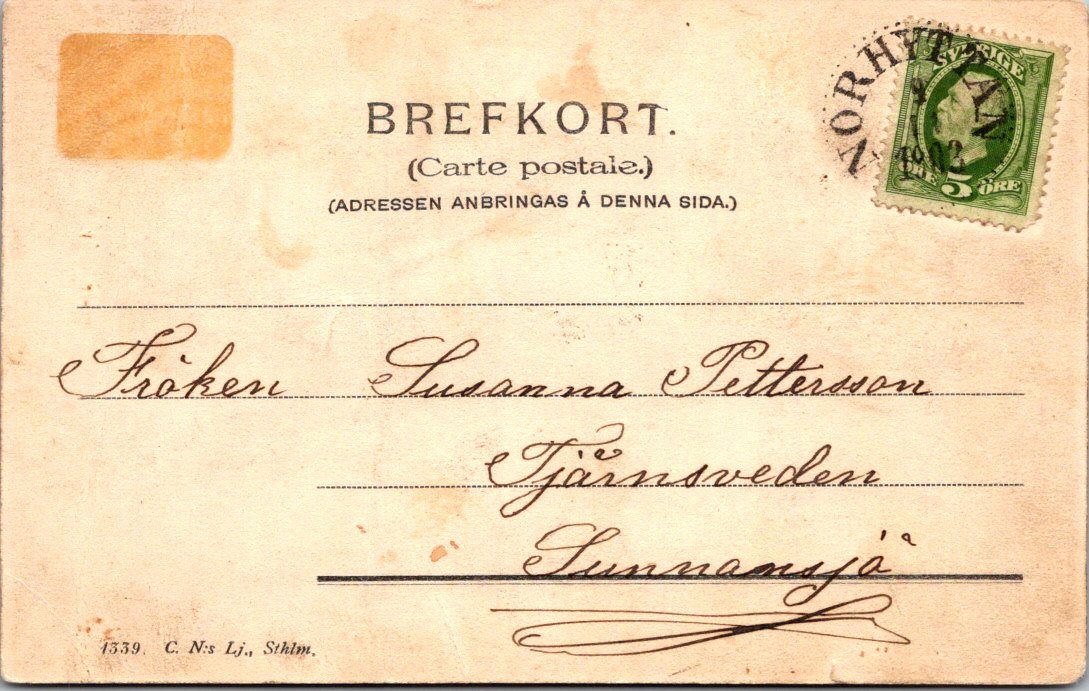
Card 1 ~ Suitor 1 from Norhyttan

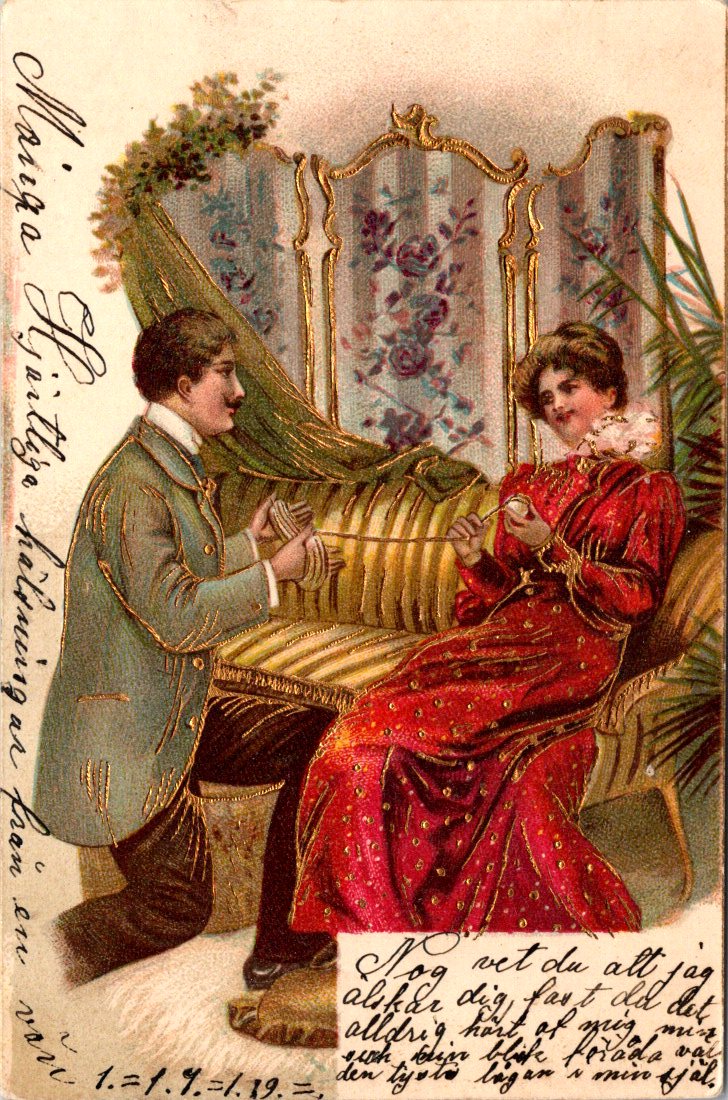
Front: An elegantly dressed couple in a richly appointed interior — man in blue-grey jacket, woman in red and gold dress — seated before an ornate folding screen painted with roses. Tropical palm in background.

Många Hjärtliga helsning av han ere…

Many heartfelt greetings from him who is [yours]…

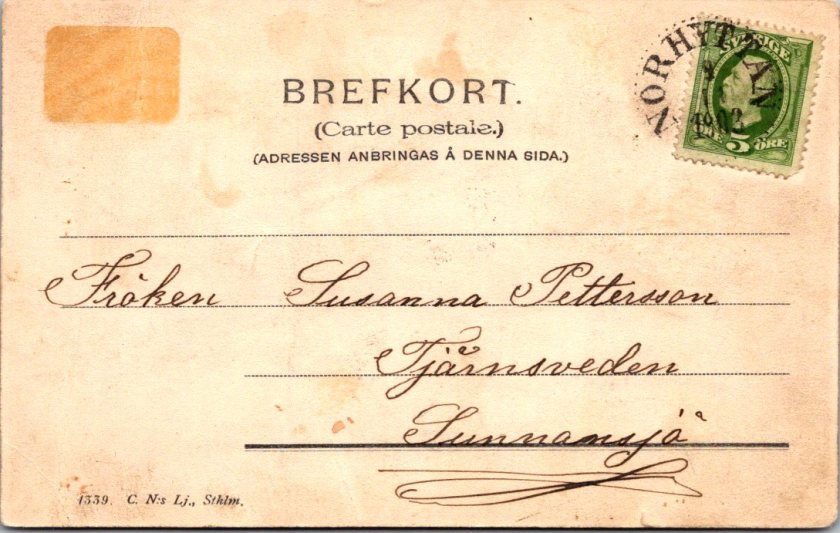
Back: Addressed to Fröken Sanna Persson, Tjärnsvedens, Sunnansjö. Note the affectionate diminutive Sanna rather than the formal Susanna used on other cards. Swedish 5 öre green stamp, Norhyttan postmark, circa 1902.

Correspondence: Lower right, heavily scripted in a practiced pen-and-ink hand. Left margin written vertically. Lower left coded notation: 1. = 1.9. = 1.19. =

Nog vet du att jag älskar dig, fast du det aldrig hört af mig, min och din blick föråda val den tysta lågan i min själ.

You surely know that I love you, even though you have never heard it from me. Mine and your glance betray the silent flame in my soul.

Production and Collector Notes: Premium chromolithograph with gold embossing, likely printed in Germany or Austria. Numbered series notation, Serie 193. Embossed romance cards of this quality with intact original Swedish correspondence are increasingly scarce. Of interest to collectors of Scandinavian ephemera, Edwardian romance, and social history researchers.


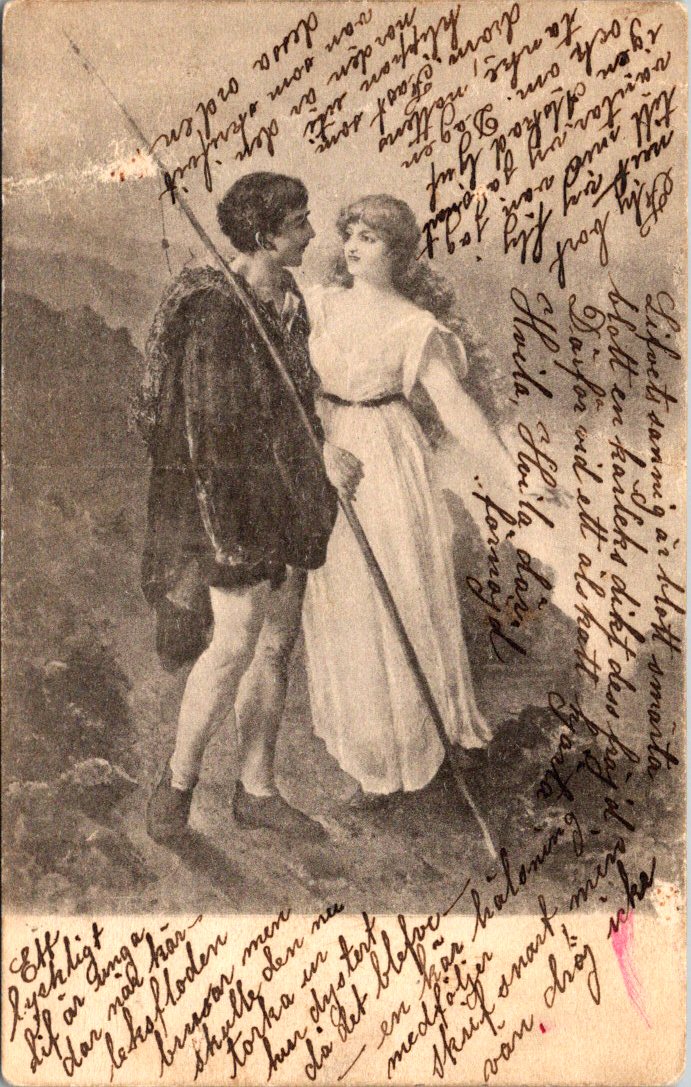
Card 2 ~ Suitor 1 from Norhyttan

Front: An archetypal couple stands on a rocky highland landscape with a misty and dramatic backdrop. A man in rough tunic carries a tall staff next to a woman in flowing white dress with loose hair.

Back: Addressed to Fröken Susanna Pettersson, Tjärnsvedens, Sunnansjö. Swedish 5 öre stamp, Norhyttan postmark.

Correspondence: Densely written in heavy hand-scripted text running in multiple directions across the image.

Elfligt lyckligt är att änga — då ned har bäksfloden bringar men nu skralla den nu torka in text hur dyster då det blefo…

Blissfully happy it is to linger — when down the brook brings / but now how gloomy / when it became…

Production and collector notes: Sepia-toned romantic lithograph published in Stockholm by C. Ns Lj., Sthlm. Series 1339. Domestic Swedish production rather than imported German print, comparatively less common for this period and market. The heroic Nordic couple reflects romantic aesthetic prominent in Scandinavian visual culture of the early 1900s. Dense multi-directional handwriting across the image face is biographically significant. Of interest to collectors of Swedish ephemera, Scandinavian social history, and scholars of private correspondence.


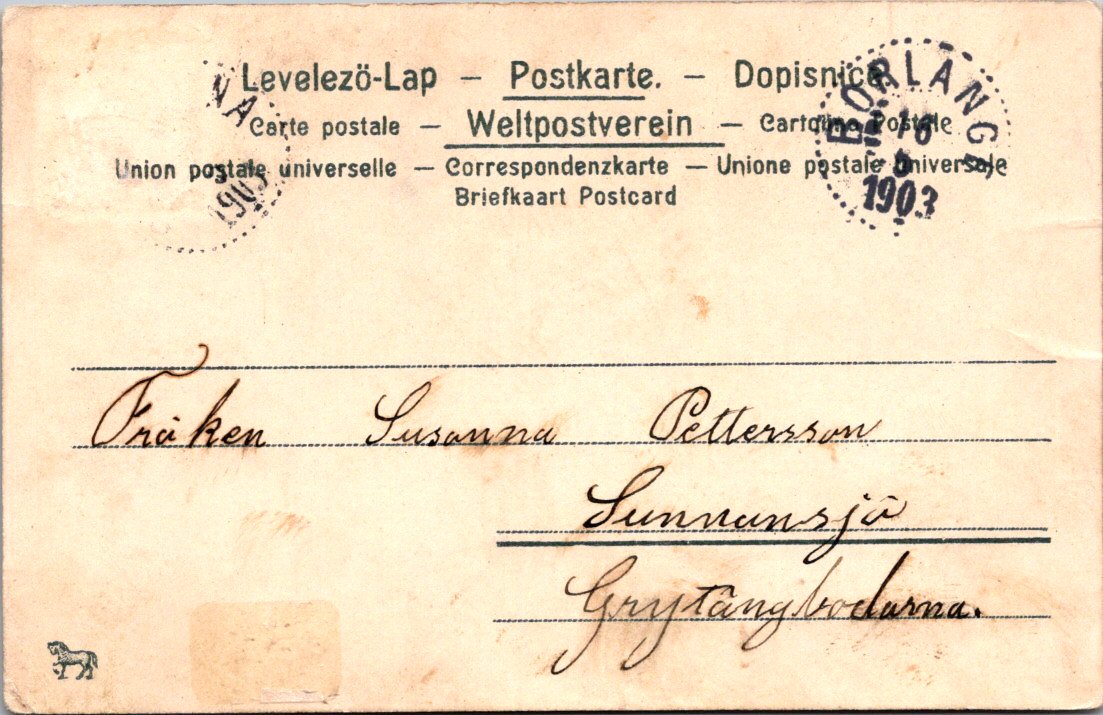
Card 3 ~ Suitor 2 from Borlänge

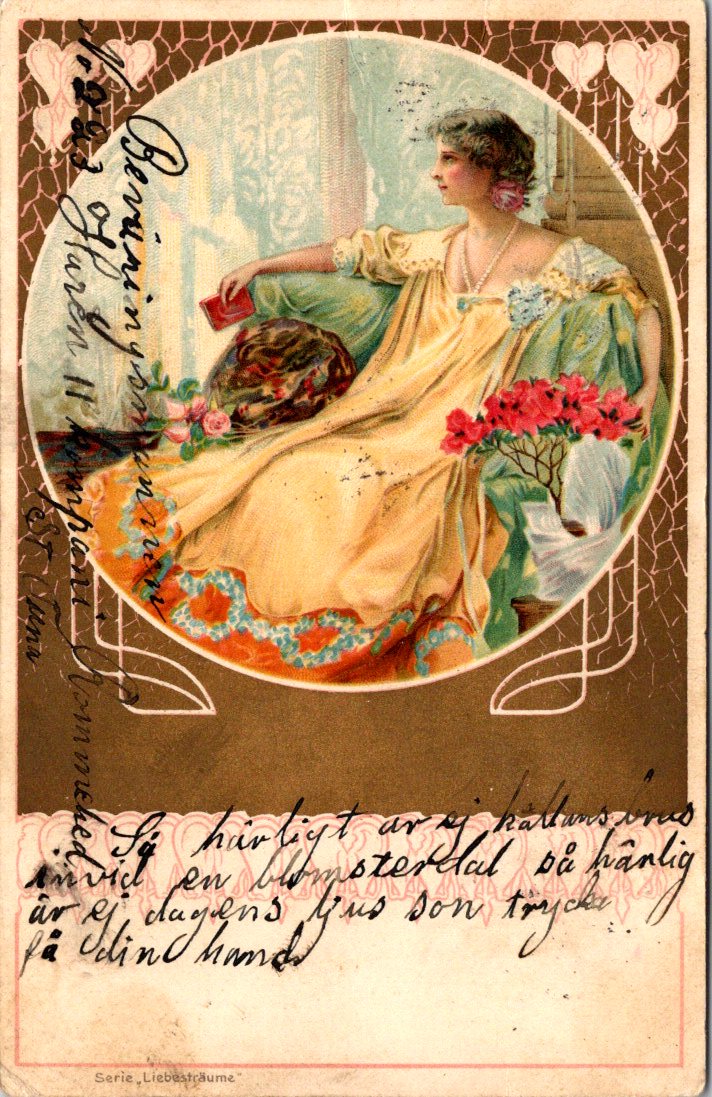
Front: A young woman in a golden-yellow gown reclines on a chaise surrounded by red azaleas and roses, holding a small red book or letter, gazing pensively to one side. Circular vignette set against a rich gold ground with pink Art Deco lattice decoration and heart motifs in each corner.

Back: Addressed to Fröken Susanna Pettersson, Sunnansjö, Gryftångbodarma. The address variation roughly translates to ‘summer farm buildings’ suggesting that Susanna was not at her main home but was staying at a seasonal outpost. Postmark, Borlänge, 1903. Small printer’s horse mark, bottom left.

Correspondence: Rounder and more casual hand-script. Left margin may be a name or family reference.

Så härligt är ej källans öras invid en blomstertal så härlig är ej dagens ljus son tryckt få din hand.

Not so lovely is the murmur of the spring, beside a flower-tale so lovely — not so bright is the light of day, as when pressed upon your hand.

Production and collector notes: Art Nouveau chromolithograph, Serie “Liebesträume” (Dreams of Love), produced by a quality German publisher and distributed internationally, reflecting Germany’s dominant role in the European postcard market of this era. Art Nouveau romance cards with intact Swedish correspondence and Borlänge postmark are notably scarce. Of interest to collectors of Art Nouveau ephemera, Scandinavian material culture, and historians of industrializing Sweden.


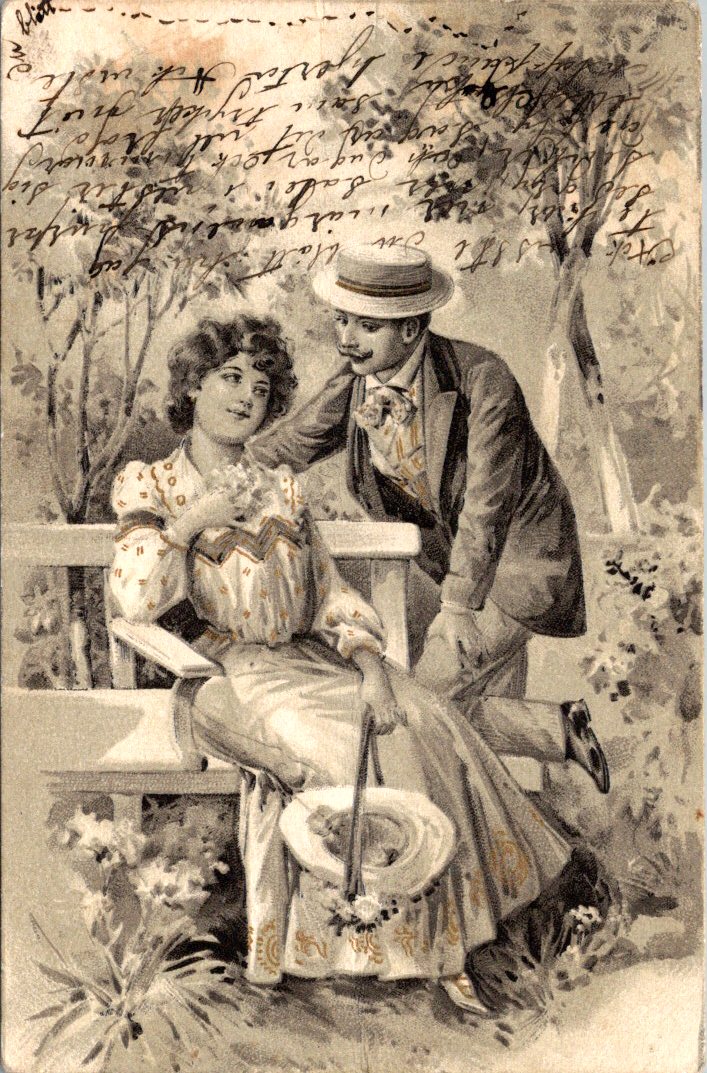
Card 4 ~ Suitor 3 from Stockholm

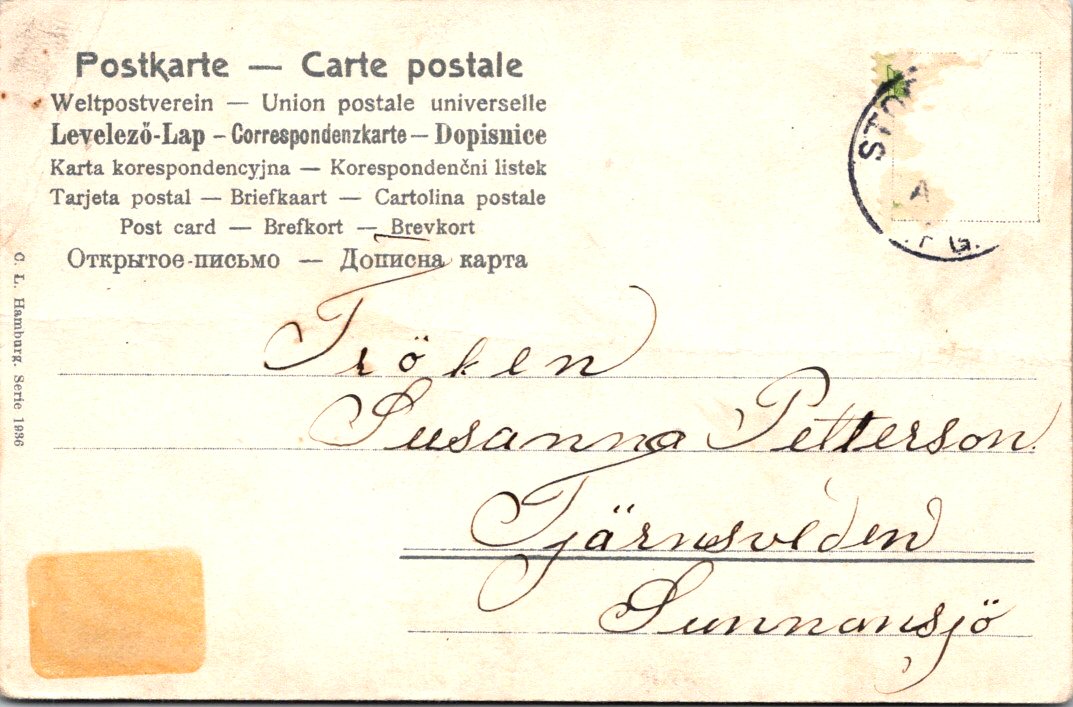
Front: A couple in a garden setting — woman in white and gold embroidered dress seated on a bench with flowers and parasol. Man in dark suit and straw boater hat leaning toward her attentively. Flowering trees surround them.

Back: Addressed to Fröken Susanna Petterson, Tjärnsvedens, Sunnansjö. Postmark origin reads Sto-, stamp damaged, full date not legible. Almost certainly Stockholm, circa 1903.

Correspondence: Written across the upper image in a compressed angular hand, distinct from both previous writers. Faded pen and ink, with partially legible fragments.

Bätt… polset… och mer… bättre…

Better… better… and more… better…

Production and collector notes: Sepia lithograph with gold highlights published by G. L. Hamburg. Serie 1896, a respected German publisher. Hamburg-published cards with intact Swedish correspondence and Stockholm postmarks from this period are collectible. Of interest to collectors of German-published romance cards and Edwardian Scandinavian ephemera.


Susanna Pettersson lived in a world that offered her limited formal choices. But in a small wooden house in Dalarna at the beginning of the last century, she could make her own quiet judgments. She could choose carefully.

Three suitors, three futures. Did she answer any of them? Whether she eventually became Fru or remained Fröken, we can’t discern from the evidence here. All we know is that she kept those four cards all those years.


Moments We Miss

Valentine’s Day is over. The chocolates parceled out, consumed in a binge, or sweetly regifted. The cards are in a stack. Love trudges on.

Before we go, there is a word worth saying about silences and the quiet costs of delayed connections, and those missed entirely.

In May 2023, the Surgeon General issued an advisory that stopped me mid-scroll. Loneliness had reached epidemic levels in the United States. He was not describing the usual suspects—a widower, a loner, someone at the edge of class or condition. I had to admit, his warning rang a bell in my own heart. I was among a growing contingent of the ordinary, ambient, alarmingly average lonely. As a caregiver, days passed without anyone really seeing me, or me really wanting to be noticed.

The Surgeon General called it a public health crisis. He compared its effects on mortality to smoking fifteen cigarettes a day. Actual harm done.

Indeed, social isolation raises the risk of heart disease, stroke, dementia, and early death. The health research is not soft or sentimental. The body registers being unseen the same way it registers physical pain — same neural pathways, same hormonal alarm signals, same disrupted sleep, same compounding risks. We are living inside a paradox: more connected by technology than any humans in history, and perhaps lonelier than our ancestors.

In the golden age of the postcard — roughly 1900 to 1920 — Americans sent billions of them. A trip to the lake. A hello from the city. A heart, a name, a single line of longing, on full view to the mail carrier and anyone else who handled it along the way. The medium demanded brevity, levity, and a light touch.

That simple approach is worth noticing, because we tend to use the absence of time as our primary excuse for not reaching out. We sense there isn’t room in the average difficult day for a real conversation. So we wait. And the time doesn’t come. And the silence grows.

A postcard is a signal, not a report. It says: I haven’t forgotten. A brief message can make a big point. At times, the whispered delivery bears the full meaning.

The research on what makes people feel less alone points not to the depth of connection in any given moment, but to its consistency. There is comfort in the reliable sense that someone, somewhere, is holding you in mind. A brief, warm gesture, repeated, does more for that feeling than an overwrought or inconsistent one.

Simple gestures are not consolation prizes. They are the architecture of belonging.

Sadly true, is often easier to extend kindness to a stranger than to sustain the loving glow among the people you know best. A stranger on a difficult day can receive warmth without a complicated history. They don’t owe you a response and you likely won’t know how the gift was felt. You haven’t let them down in the small accumulated ways that life’s closeness allows.

The people we love most are the ones we are most likely to let drift or actively ignore. A peculiar paralysis comes with the familiar foibles, caring deeply, and feeling the gap widen.

So here is a gentle nudge, the week after the holiday, when the pressure is off and the expectations are low. Not because it’s February. Because it’s Wednesday, and someone who loves you needs to know. A postcard or a hug, a humble tug on the sleeve or a quiet walk. None of it asks or offers too much. A simple, “We are ok,” can be enough.


Long Distance Love Languages

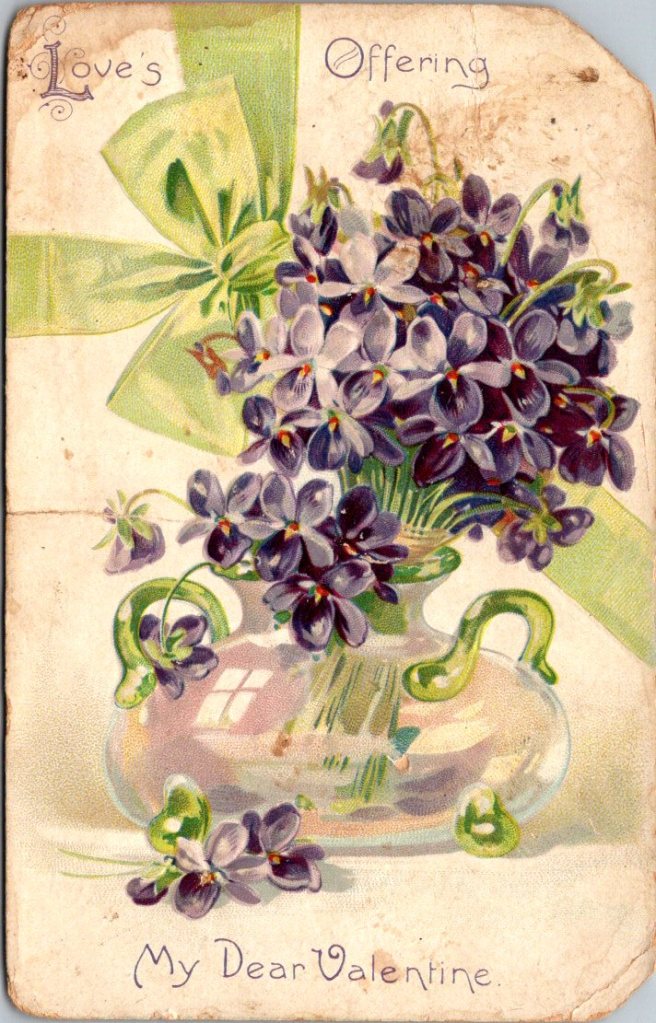
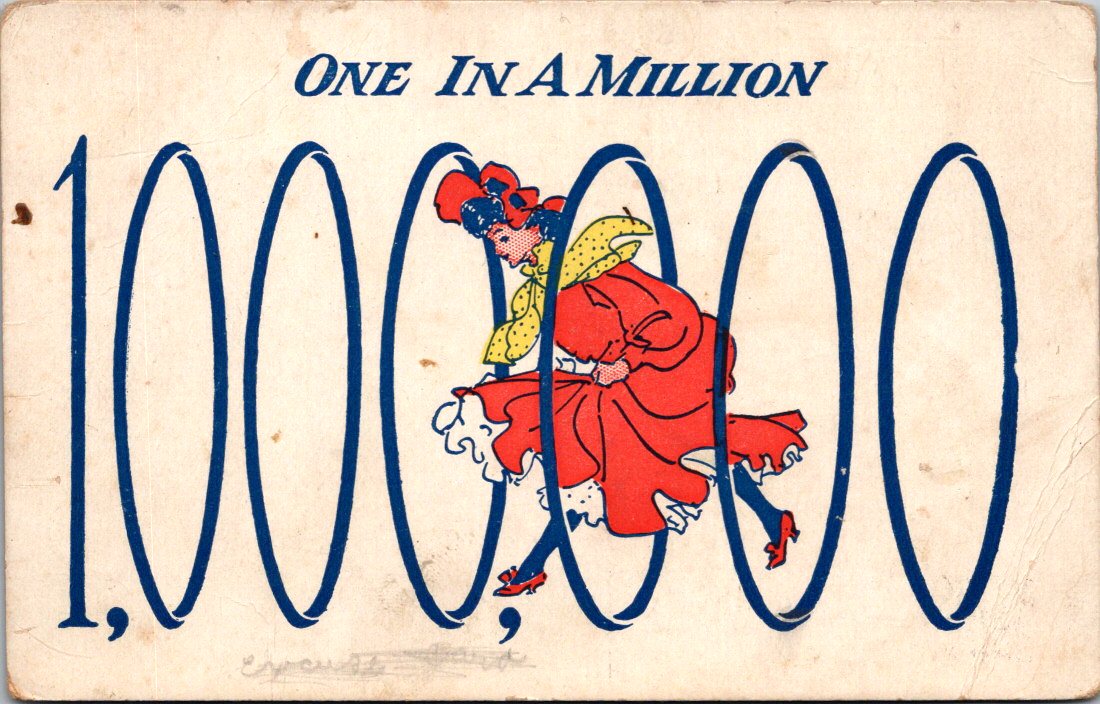
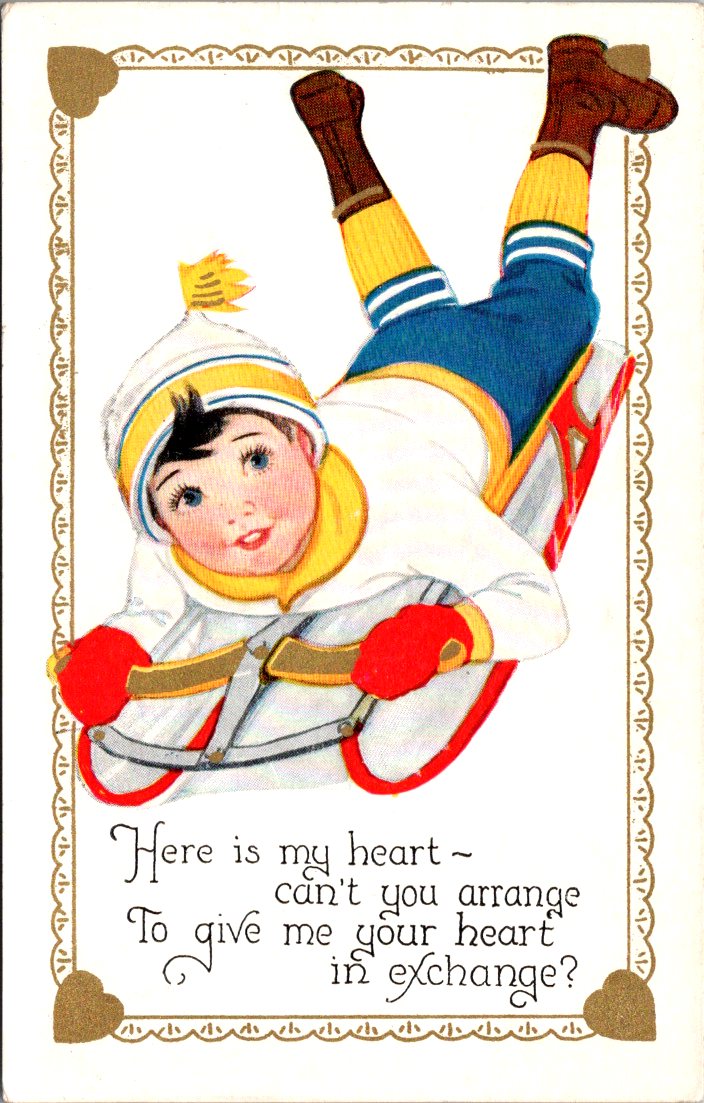
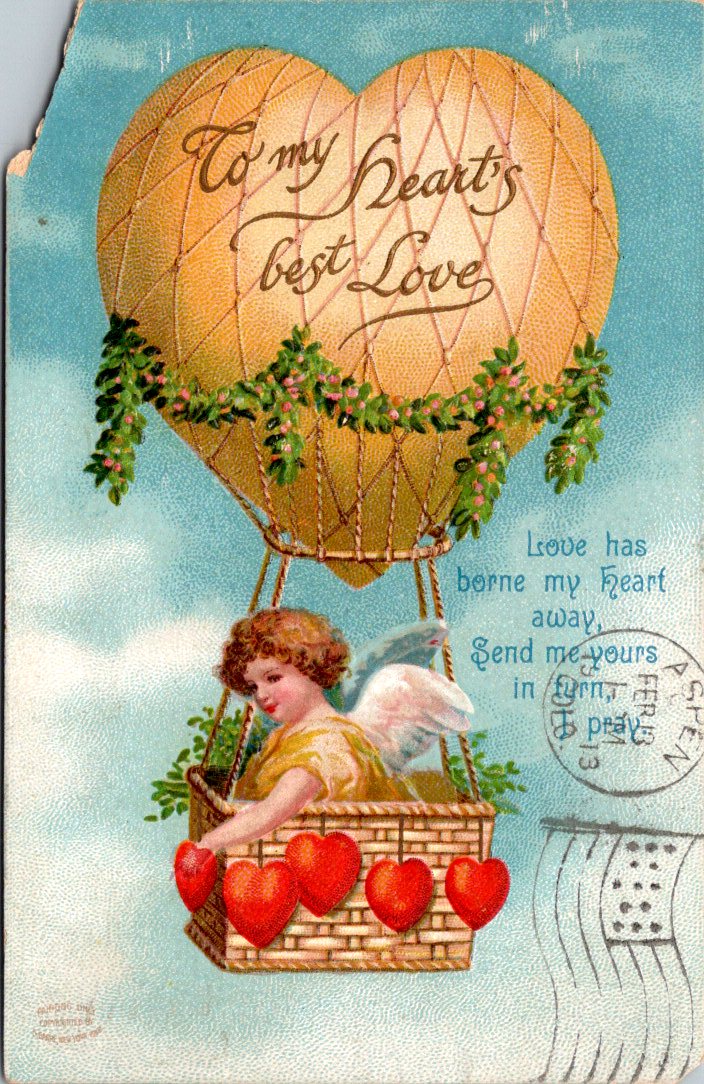
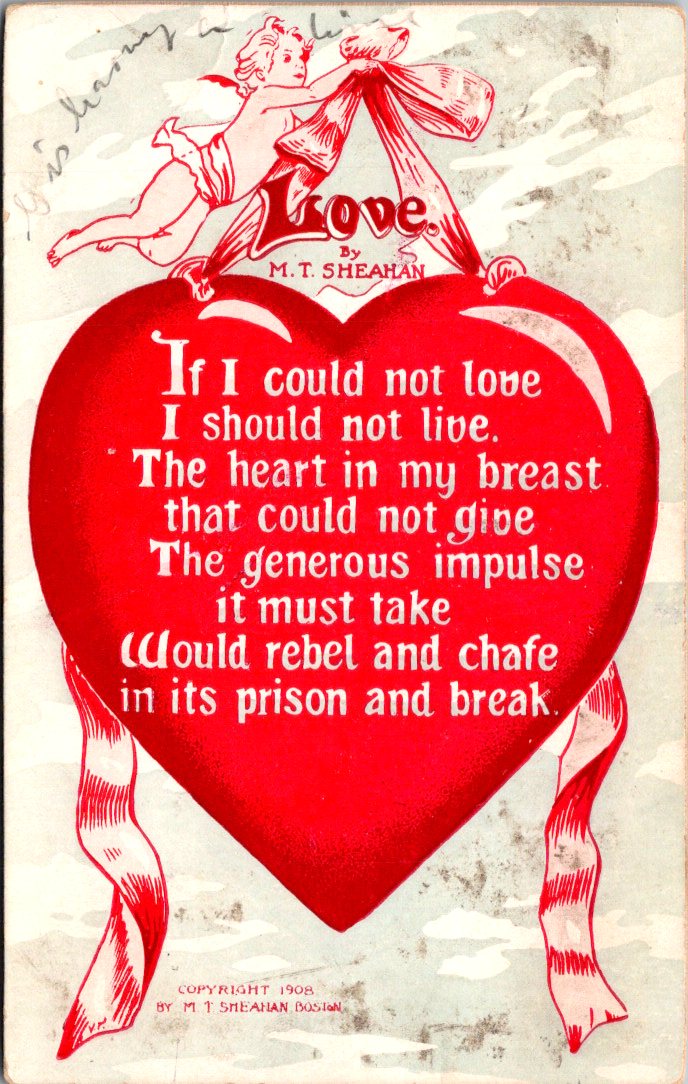
I don’t dare reveal the flipsides of the love-laced cards you’re about to see. What Ida, Minnie, or Gertrude sent or received isn’t for you or me.

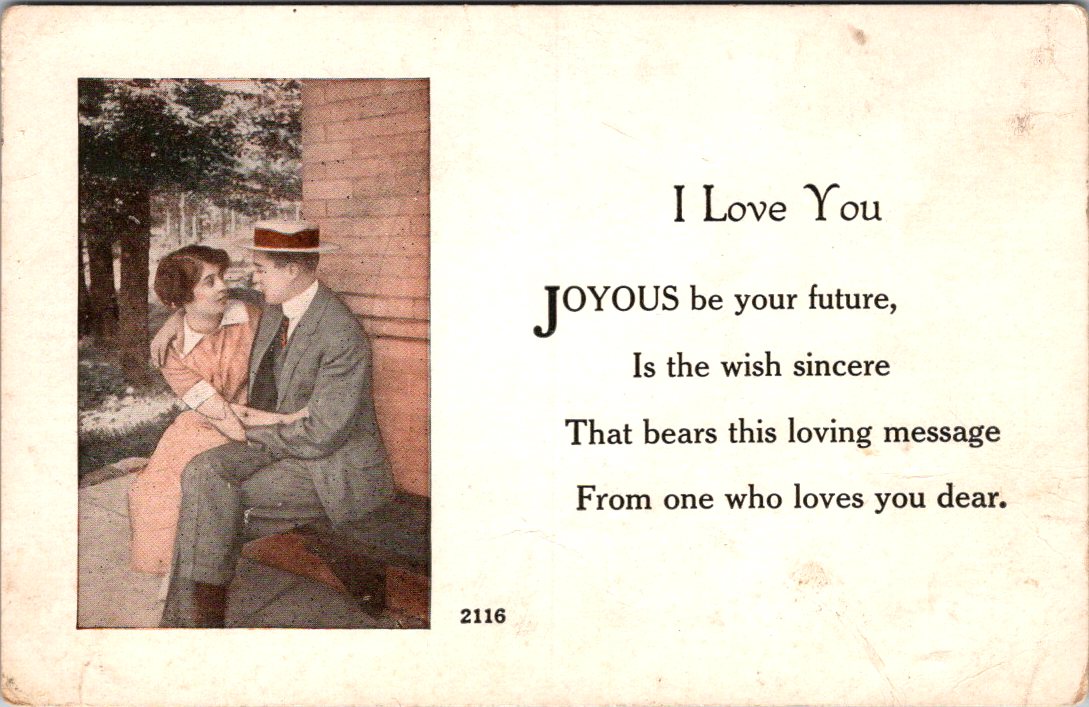
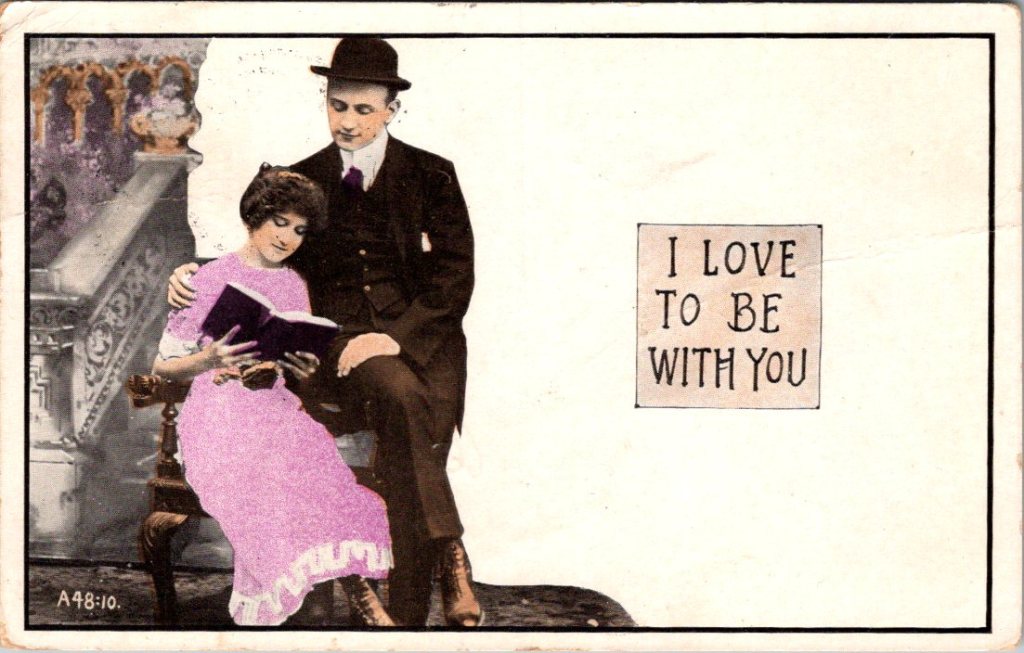
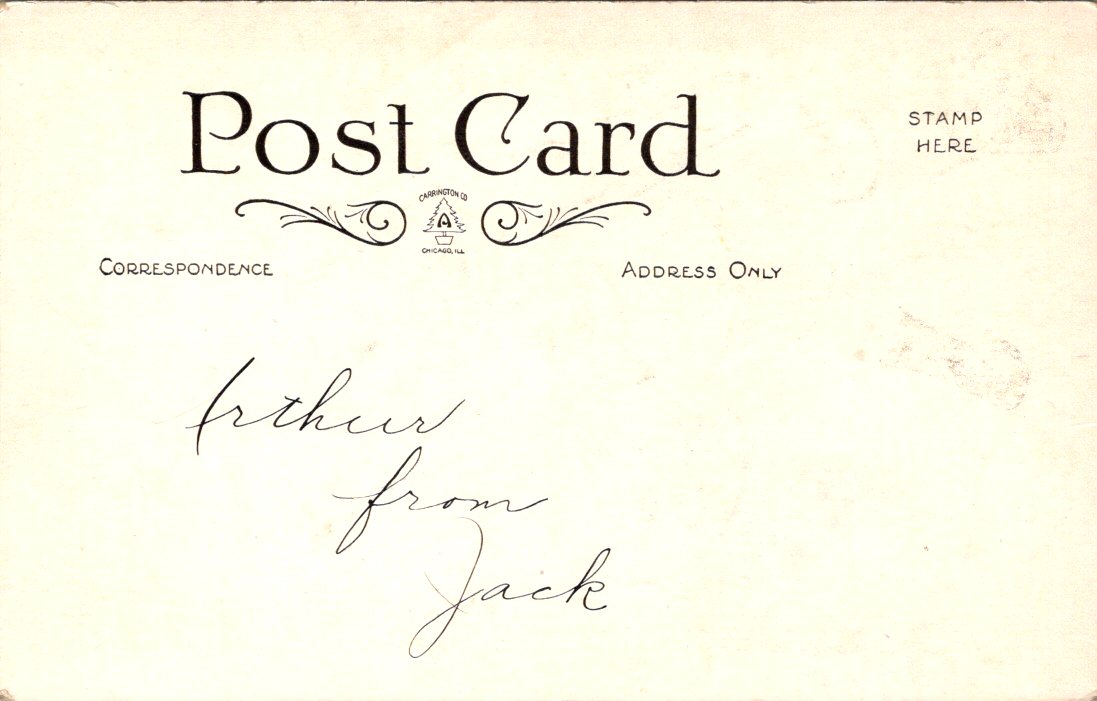
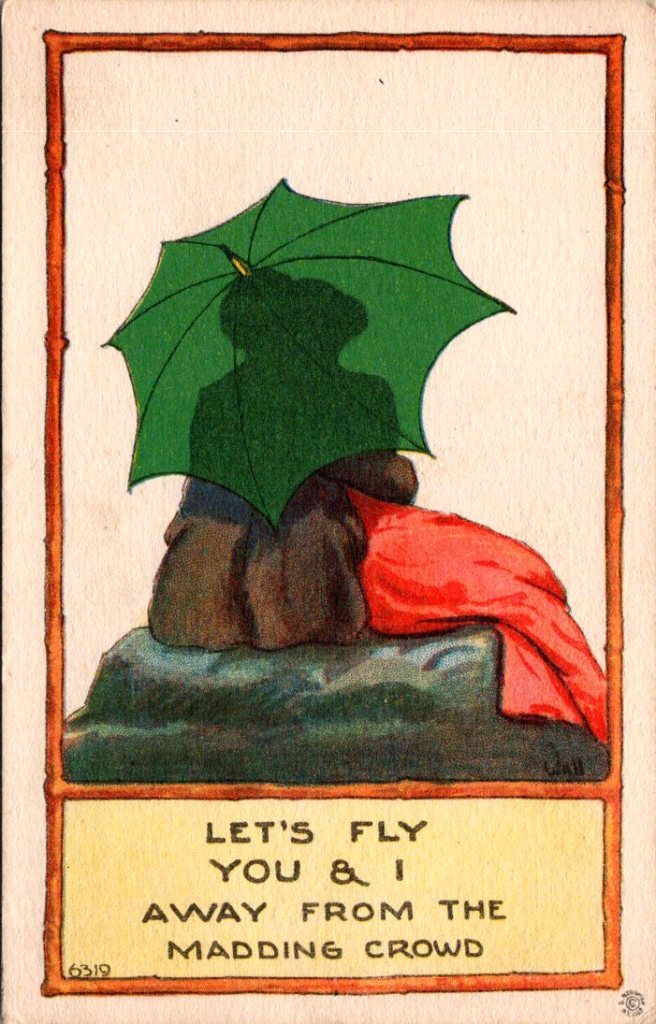
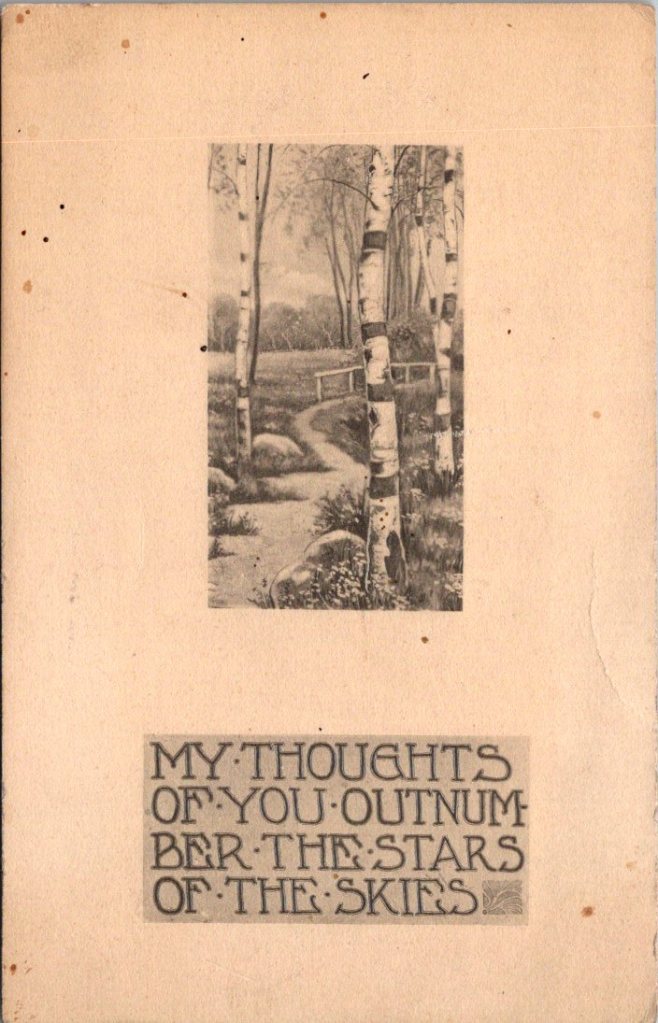
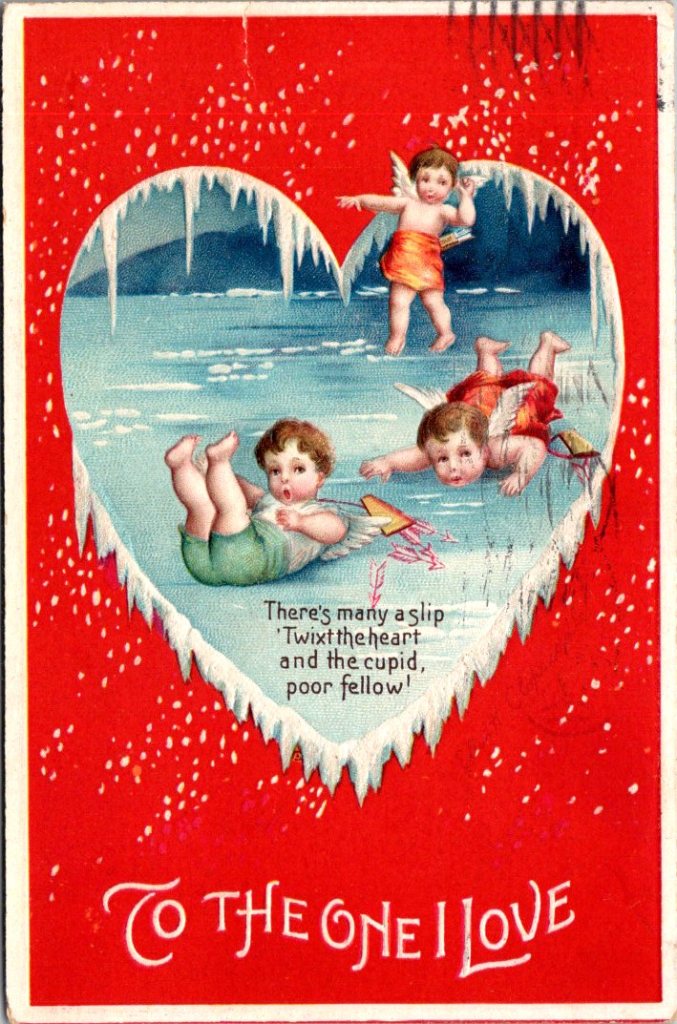
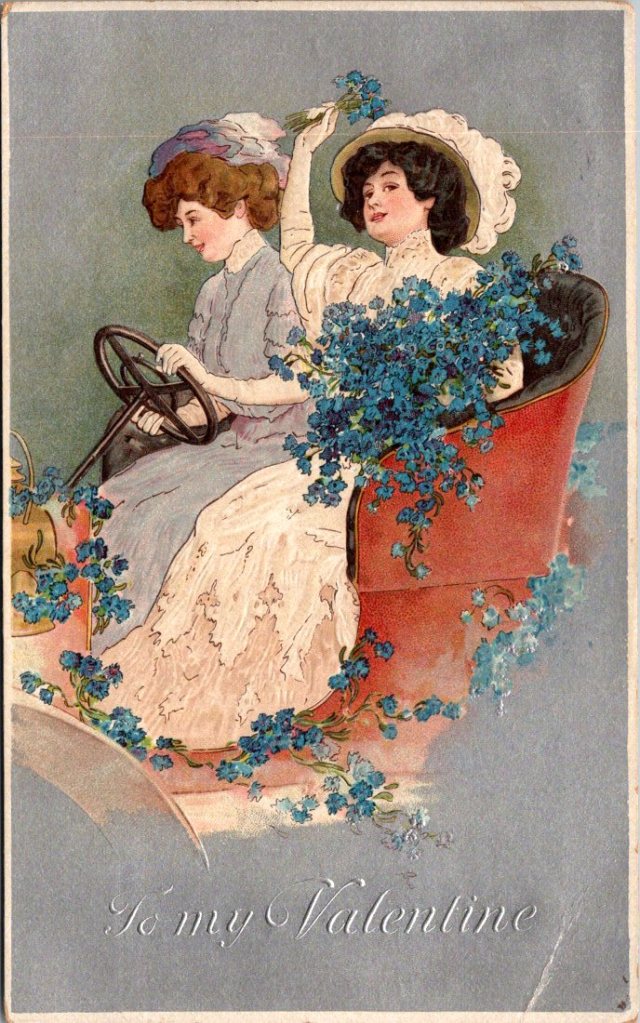
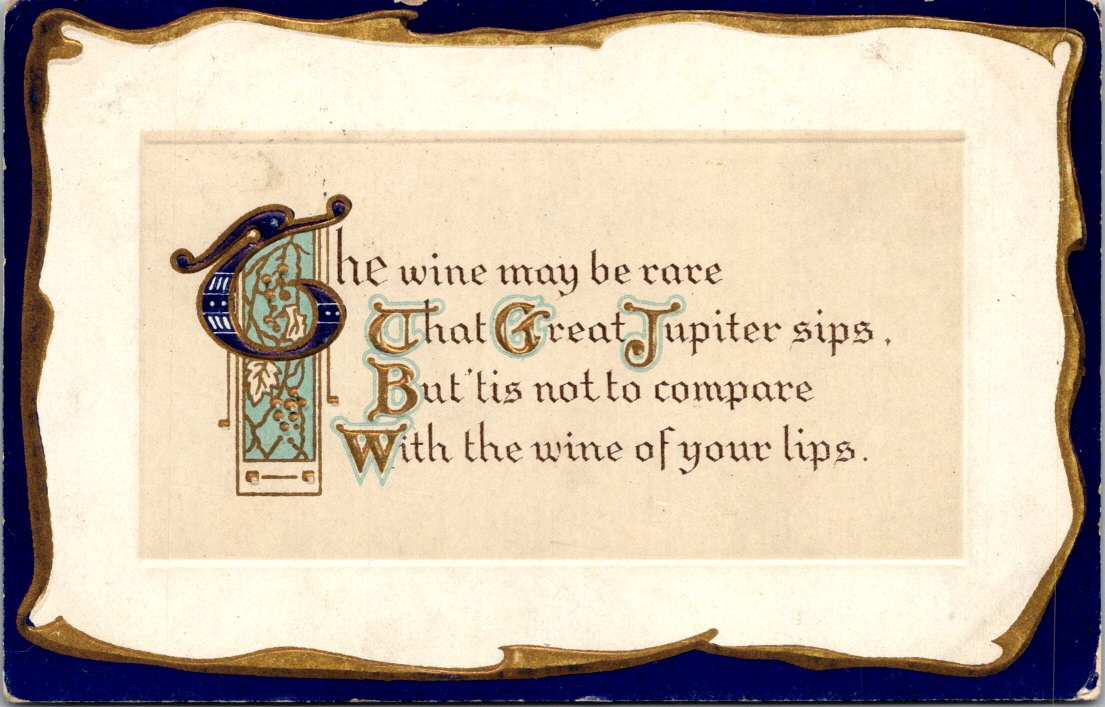
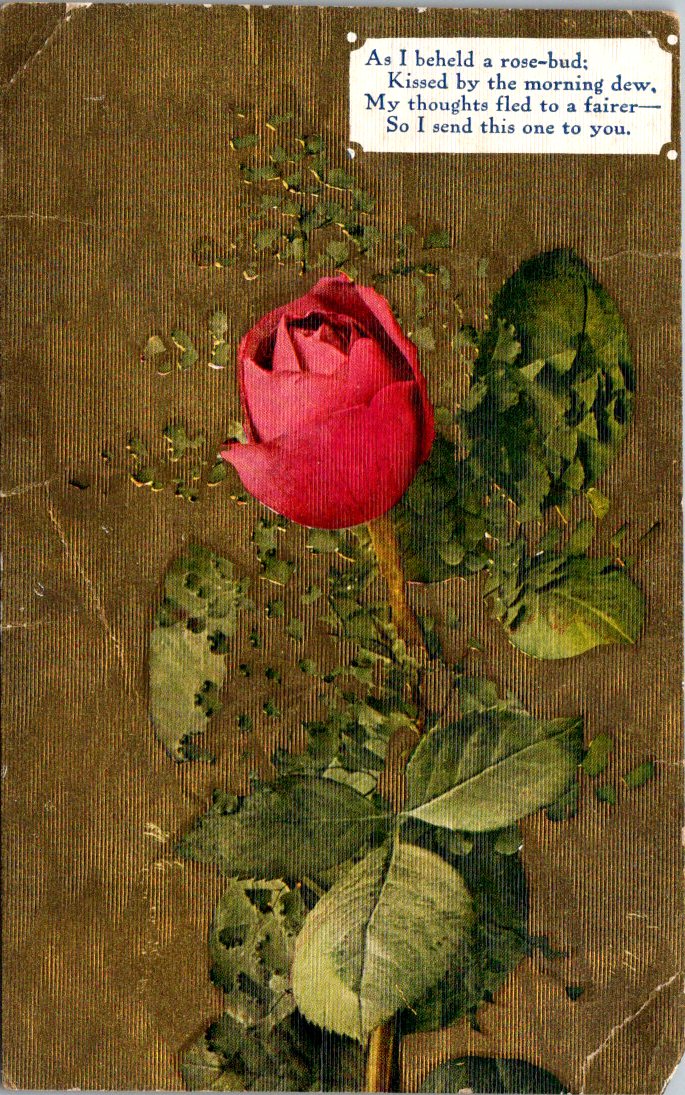
Hand-delivered to Arthur from Jack, this first example is our single exception. With a humble request and an elegant script, we can only hope the romance of a lifetime began, heated up, or settled in. Maybe it was placed on the pillow that morning, sometime before 1907 when postcards still featured undivided backs.

My own love is famously far afield. In the early days, our photograph appeared in a magazine alongside a short interview on the workings of our long-distance affair. We were an ocean away in those days, and on the adventure of a lifetime together. It could be a car drive now, albeit a very long one. Always tempting!

Languages are a passion and a profession for my lady linguist. So a few more out of pure fun and fascination. Luf yah!

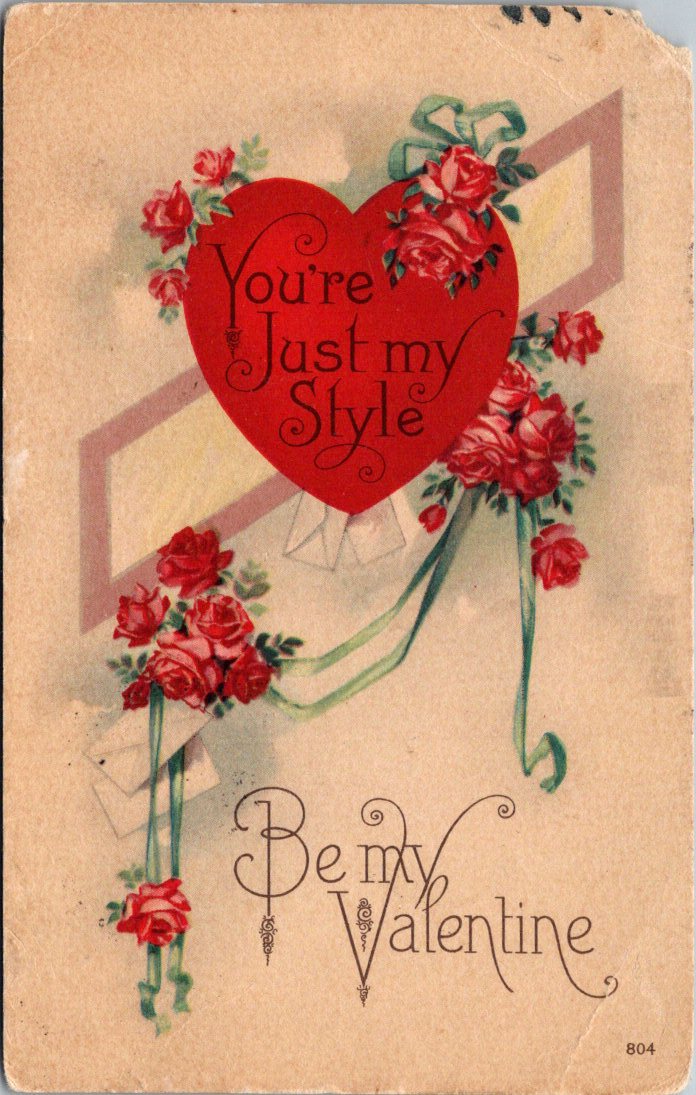
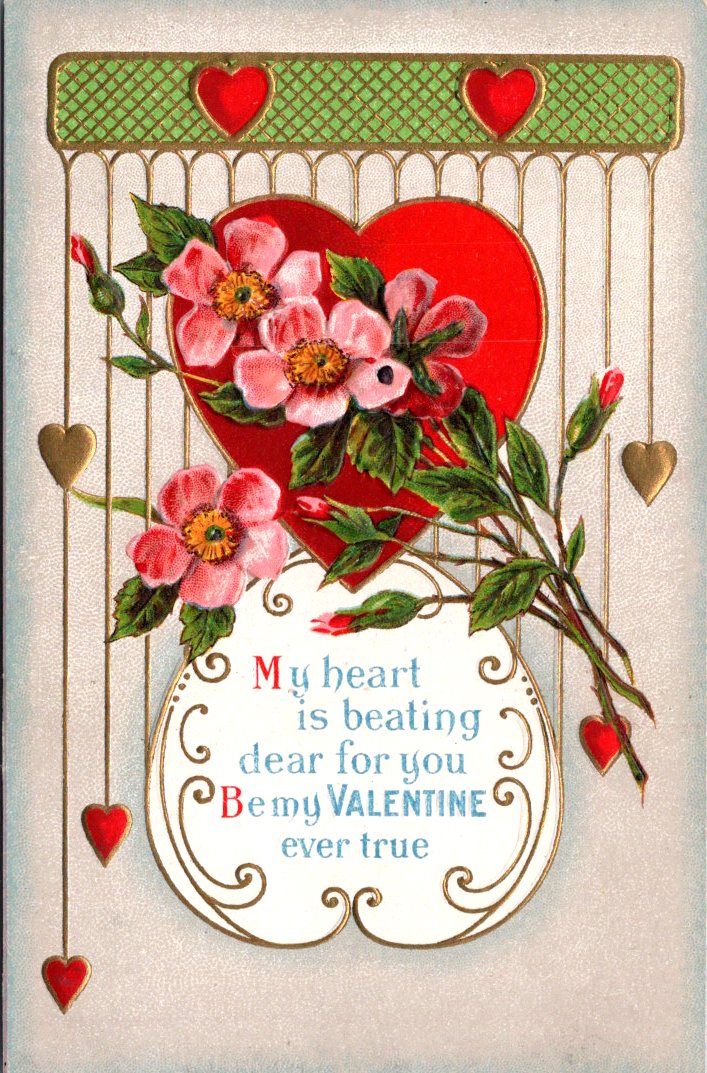
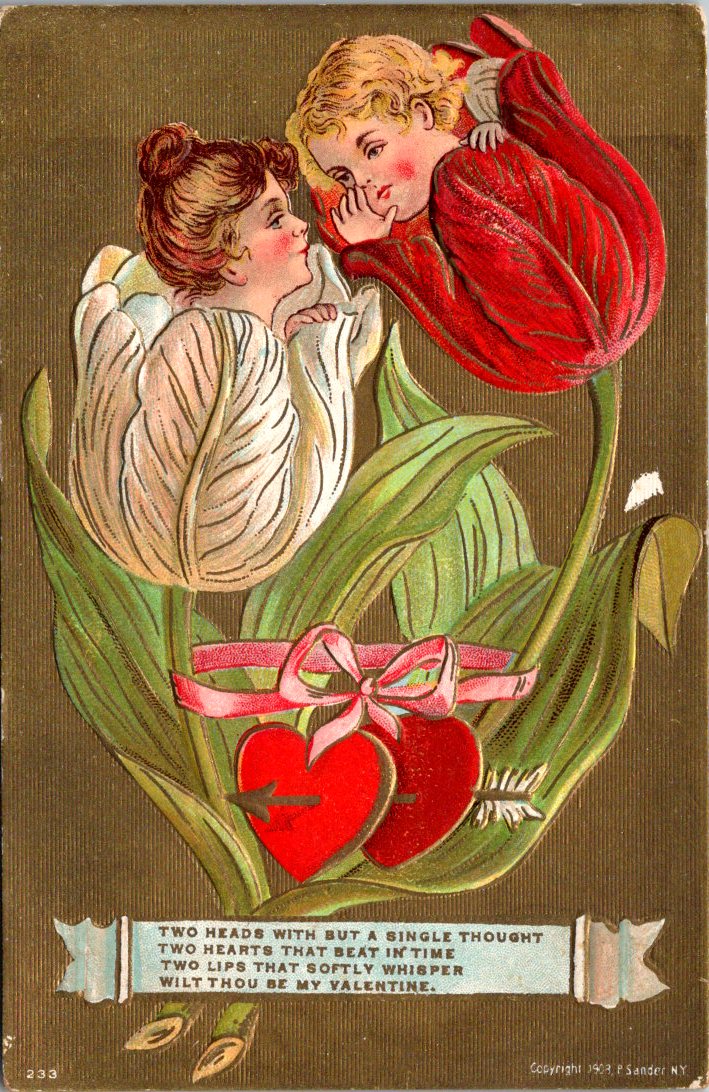
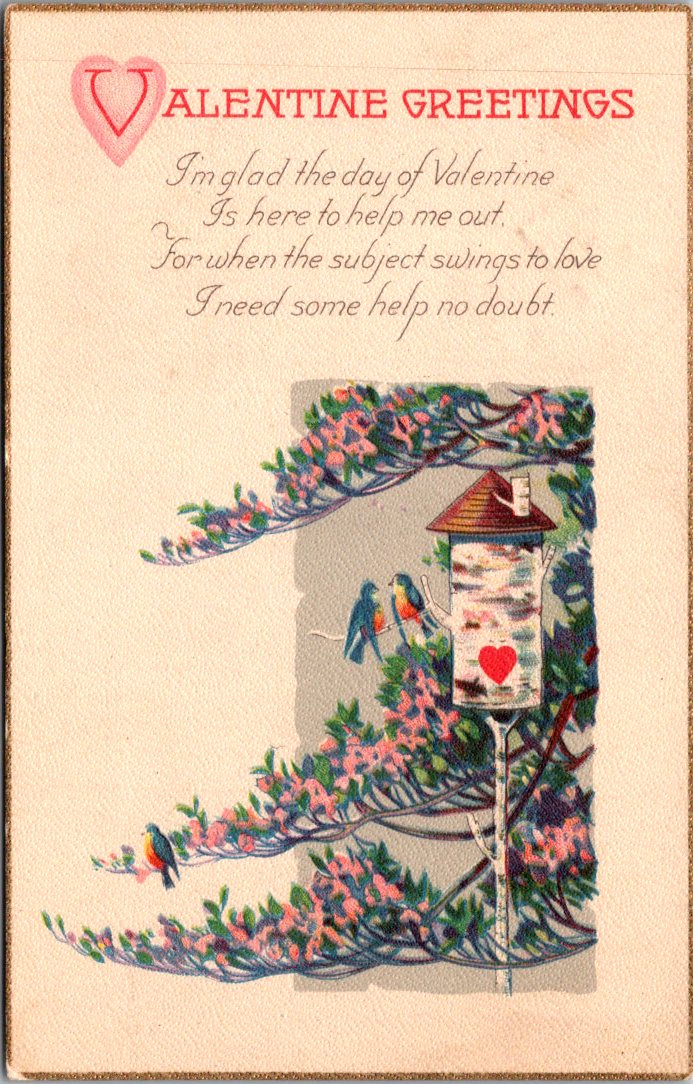
Dear readers, I promised you hearts and flowers after that awkward spell last week. First, a gallery carefully curated on the theme. Then, elucidations and another peek.

Made-for-you messages with showy sentiments on full view to your pa, your ma, and the mail carrier, too.

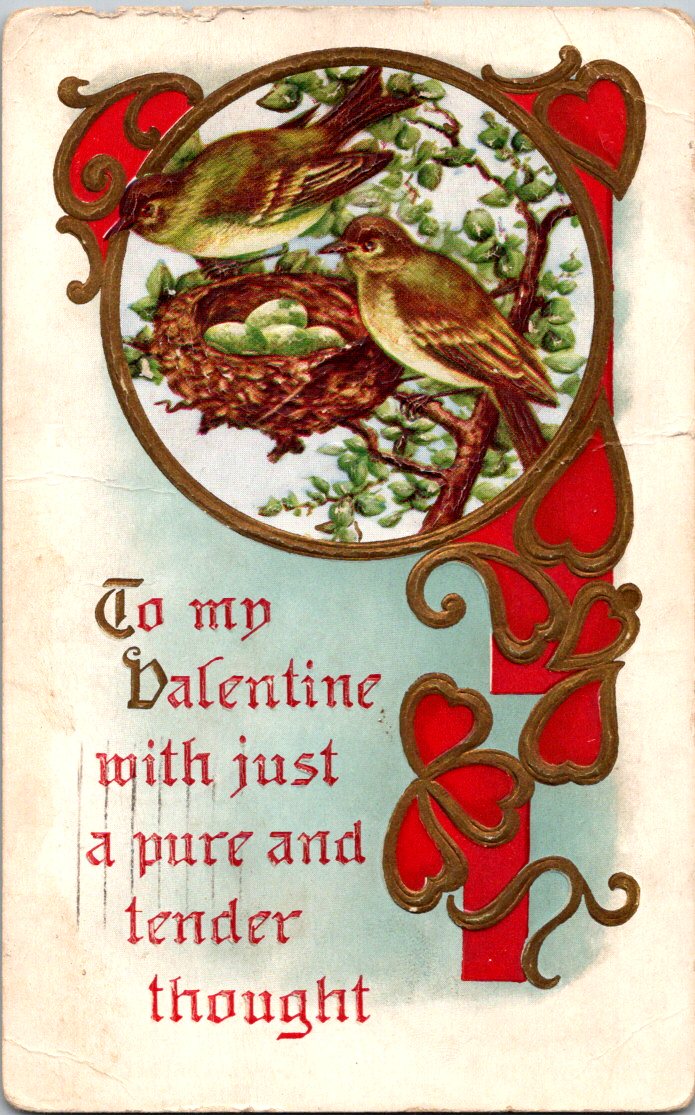
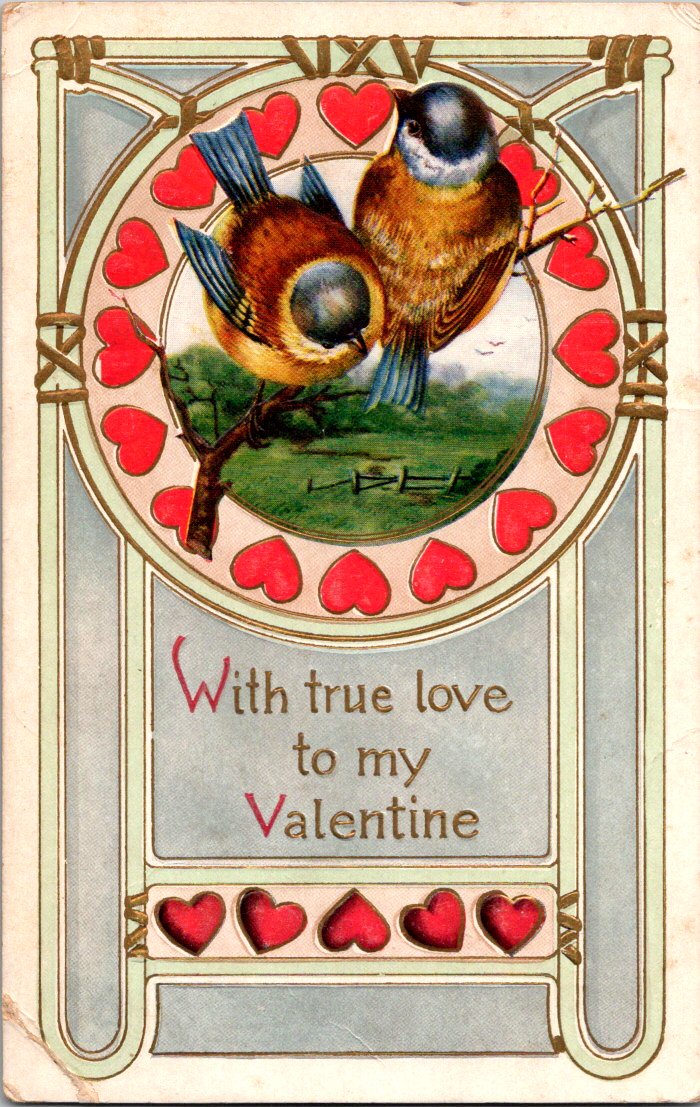
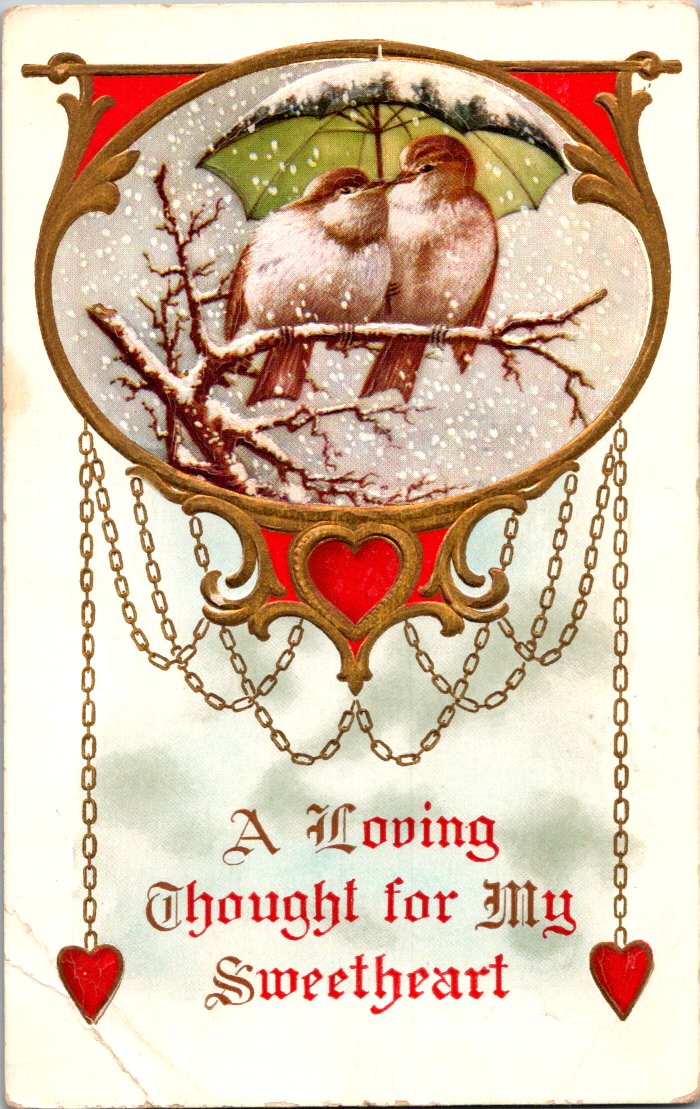
Some parts are still snowy, as love lamps flicker on in February. Hearts, words, and birds arrive in the quiet winter glow. Rest inside a circle of love. When you know, you know.

Leery of Love

We’ll get to the hearts and flowers. But first, this is awkward.

It’s February. Congratulations if you have accomplished anything this year.

I spent the morning sorting through Valentine’s greetings. Love is in the air, and rest assured there are albums full of gorgeous arrangements and heartfelt sentiments in the weeks ahead.

But first, I need to bring up something awkward. Not everyone loves this sweetheart’s holiday. For the lovelorn, it’s excruciating. For the grieving, a sad set of reminders. For the wicked, a chance to lance the joy bubbles in the air.

In postcards, we have to acknowledge the neck strain.

Also, captions that might have meant exactly what they suggest.

Lastly, those with an anti-Valentine vibe, a bad bargain, or even a threat!

We will return next week to the regular schedule of sweetness and light, heart and flowers, charm and chocolate, passion and promises. How… delightful!


Reminder, recent story series are at the Wednesday Weekly Reader. This month, you might also enjoy an old yarn about embroidered postcards.

The Posted Past

We trade loneliness for connection, one postcard at a time

Skip to content ↓